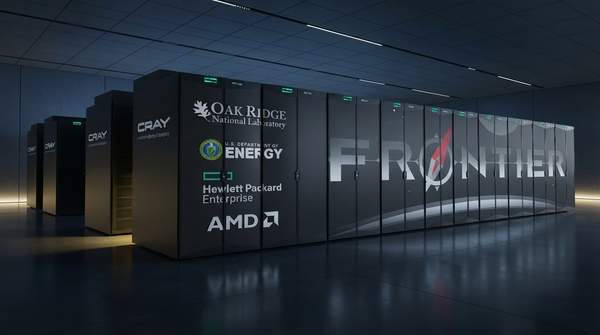
Adapting complex scientific software for the world's most powerful exascale supercomputers requires a fundamental redesign that goes far beyond a simple code update. The primary challenge stems from the diverse and specialized hardware architectures of these new machines, particularly the mix of traditional central processing units (CPUs) and various graphics processing units (GPUs). To solve this, developers are widely adopting performance portability abstraction layers—specialized software libraries that allow a single application codebase to run efficiently on different types of hardware without being rewritten for each one.
The Exascale Imperative for Scientific Software
The arrival of exascale computing, capable of a billion billion calculations per second, represents a monumental leap in processing power. However, harnessing this capability for scientific discovery depends on preparing sophisticated software to run on these novel systems. In 2015, the U.S. National Strategic Computing Initiative established the Exascale Computing Project (ECP) to address this very issue. According to a U.S. Department of Energy report, the ECP was tasked with "bridging the gap between the previous and next generation of hardware" to ensure critical scientific applications could effectively use the new systems. This effort was necessary because the shift from computers based on multicore CPUs to those reliant on nodes with multiple GPUs demanded more than a simple "porting" of existing code. It required significant investment in redesigning algorithms and software from the ground up.
Hardware Diversity: The Core Exascale Software Challenge
The central software problem for exascale computing is managing hardware heterogeneity. As supercomputer development progressed, it became clear that future systems would rely on diverse components, including CPUs with much higher core counts, specialized hardware, and accelerators like GPUs. This created uncertainty about how the vast range of scientific applications could be adapted to perform well on any given machine. A Department of Energy report noted that making effective use of an exascale supercomputer would necessitate "innovative computational technologies, with new approaches to algorithm design, programming, and code optimization." Writing and maintaining separate versions of a complex scientific code for each potential hardware configuration—one for NVIDIA GPUs, another for AMD GPUs, and yet another for Intel's—is impractical and unsustainable. This challenge prompted a search for a unified software solution.
The Performance Portability Software Stack
The solution that has emerged is a software architecture centered on performance portability layers. These are programming frameworks that act as an intermediary, decoupling the scientific application from the specific hardware it runs on. This model allows developers to write their scientific code once using the framework's commands, which are then automatically translated into optimized instructions for whatever hardware is present on the supercomputer. This approach avoids the need to maintain multiple, hardware-specific versions of the same application.
This software stack can be understood in three layers:
- Scientific Application: At the top is the scientific code itself, such as the molecular dynamics simulator LAMMPS. This layer contains the high-level logic for the simulation or model being run.
- Performance Portability Layer: In the middle sit libraries like Kokkos and RAJA. These frameworks provide a single programming interface for developers. RAJA, for instance, is a high-level abstraction developed at Lawrence Livermore National Laboratory to allow code to use whatever hardware is available on a system's backend. It helps move codes from one type of computing architecture to another.
- Diverse Hardware Backends: At the bottom is the physical hardware, which can include CPUs and GPUs from different vendors. The portability layer translates the application's instructions into the specific parallel computing language of the backend, such as CUDA for NVIDIA GPUs or OpenMP for CPUs.
By inserting this abstraction layer, the scientific community can develop applications that are ready for exascale systems without being locked into a single hardware vendor. The Exascale Computing Project supports the development of these programming models to address the challenges of combining massive concurrency on next-generation node architectures and improving performance portability.
Beyond Portability: Other Exascale Software Challenges
While achieving performance portability is a cornerstone of the exascale software strategy, it is not the only challenge. The complexity of these new systems introduces several other hurdles that require innovation and collaboration across scientific disciplines.
One major issue is memory management. The intricate memory hierarchies of GPU-based systems require careful handling of data movement between the main CPU memory and the GPU's dedicated high-bandwidth memory. According to a researcher at Lawrence Livermore National Laboratory, the approach being developed to manage memory on the current generation of GPU-based machines will be extended to exascale computers. This involves creating tools that can work in tandem with portability software like RAJA to optimize data transfers.
Furthermore, the sheer scale and complexity of exascale machines make it difficult to diagnose performance bottlenecks. New tools and techniques are needed to understand why a code may be running slowly and how to optimize it. The entire effort requires years of collaborative work, bringing together experts in algorithm design, programming, and computer science to build a sustainable and open software ecosystem.
Navigating the Exascale Software Landscape
To fully leverage the power of next-generation supercomputers, scientific software developers must adopt performance portability frameworks and address a broader set of software engineering challenges. The move to exascale is not a simple hardware upgrade but a paradigm shift that demands new software strategies. The work done through initiatives like the Exascale Computing Project to create abstraction layers such as Kokkos and RAJA provides a viable path forward, enabling a single codebase to thrive across a diverse and evolving hardware landscape. The ultimate measure of success will be the successful deployment and efficient execution of scientific applications on diverse exascale architectures, evidenced by performance benchmarks that demonstrate these complex codes are truly ready for the future of high-performance computing.
Sources
- Preparing Scientific Applications for Exascale Computing — Brookhaven National Laboratory
- Research - Exascale Computing Project
- OSTI
- LAMMPS & Kokkos — Consortium for the Advancement of Scientific Software
- The Exascale Software Portfolio — STR