At the heart of most large galaxies, including our own Milky Way, resides a supermassive black hole (SMBH), a gravitational titan millions to billions of times more massive than the Sun. These objects are not merely passive cosmic anchors; they are active engines that profoundly influence the development of their galactic hosts. The growth of an SMBH and the evolution of its surrounding galaxy are deeply connected in a process of co-evolution. This intricate relationship is governed by two primary growth mechanisms: the steady consumption of interstellar gas and the cataclysmic merger of galaxies.
Astrophysicists have established that supermassive black holes grow through these two main channels—accretion of matter and merging with other black holes. This growth is not an isolated phenomenon. As NASA scientific materials explain, a strong correlation has become evident between the properties of galaxies and the growth of their central SMBHs. Observations over the past two decades have revealed that a black hole's mass is closely linked to the stellar mass and the velocity of stars in its galaxy's central bulge. According to the TMT International Observatory, this has led to the popular idea that black holes and galaxies co-evolve, with the energetic output from a growing black hole heavily impacting the gas supply and star formation within its host.
Mechanism 1: Gas Accretion and AGN Feedback
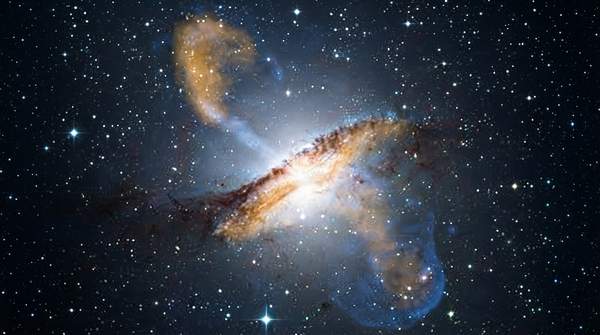
The most persistent method of SMBH growth is accretion, the process of pulling in and consuming surrounding gas and dust. As this material spirals inward, it forms a searingly hot, luminous structure called an accretion disk. The immense gravitational and frictional forces within this disk heat the matter to extreme temperatures, causing it to radiate vast amounts of energy across the electromagnetic spectrum. When this process is particularly intense, the galaxy's core can outshine all the stars in the galaxy combined, becoming what is known as an Active Galactic Nucleus (AGN).
This energetic output from the AGN creates a powerful "feedback" loop that regulates the host galaxy. The energy released by the accreting black hole can drive galactic-scale outflows, shaping the galaxy's evolution. According to a topic summary in Nature Index, these feedback mechanisms take two primary forms. The first is radiatively driven winds, where the intense light from the accretion disk exerts pressure on the surrounding gas, pushing it away. The second is mechanical feedback from powerful, collimated jets of material launched from the black hole's vicinity at nearly the speed of light. These jets plow through the galaxy, inflating huge cavities and shocking the ambient gas.
The primary consequence of this feedback is the suppression, or "quenching," of star formation. Stars are born from cold, dense clouds of gas. AGN feedback heats this gas or expels it from the galaxy entirely, removing the raw material needed for new stars to form. This process is considered a crucial solution to the "overcooling" problem in cosmology, which questions why massive galaxies are not much larger than they are; feedback from their central black holes appears to act as a thermostat, preventing runaway star formation. This influence can extend far beyond a single galaxy.
Research from the University of Arizona suggests an active SMBH can affect star growth in neighboring galaxies millions of light-years away, creating a "galaxy ecosystem." While once thought to be relevant only for massive galaxies, recent simulations show AGN feedback also plays a key role in the evolution of smaller dwarf galaxies.
Mechanism 2: Galaxy Mergers and Starbursts
The second, more violent pathway for SMBH growth is through galaxy mergers. When two galaxies collide, their structures are disrupted by immense gravitational forces. Over millions of years, they combine, and their central supermassive black holes sink toward the new galactic center, eventually coalescing into a single, more massive black hole. These cosmic collisions are transformative events that reshape the galactic landscape and provide a sudden, massive fuel source for the central black hole.
The gravitational chaos of a merger funnels enormous quantities of gas and dust toward the galactic core. This sudden influx of material provides a feast for the newly merged black hole, fueling a powerful burst of accretion and AGN activity. Simultaneously, the compression of gas clouds throughout the merging galaxies triggers a furious, short-lived episode of star formation known as a "starburst." During a starburst, stars can form at a rate hundreds of times greater than in a typical galaxy. This process links the catastrophic growth of the central black hole directly to a period of rapid stellar population growth in the host galaxy.
These merger events are also believed to be fundamental to building the structure of galaxies themselves. The strong correlation observed between a black hole's mass and the properties of its host galaxy's bulge suggests that the same merger events that grow the black hole also contribute to building up the central, spheroidal component of the galaxy. The co-evolutionary model posits that as galaxies grow through mergers, so do their black holes, with each process influencing the other in a tightly coupled dance.
Comparing SMBH Growth Mechanisms and Their Galactic Impact
| Growth Mechanism | Primary Fuel Source | Impact on Host Galaxy Star Formation | Impact on Host Galaxy Structure |
|---|---|---|---|
| Gas Accretion | Steady inflow of surrounding interstellar gas and dust into an accretion disk. | Powers an Active Galactic Nucleus (AGN), whose feedback (winds and jets) heats and expels gas, slowing or stopping star formation in a process called "quenching." | Drives a long-term co-evolution, linking the black hole's mass to the properties of the galaxy's central bulge (e.g., the M-sigma relation). |
| Galaxy Mergers | The coalescence of two central black holes, plus a massive, rapid inflow of gas driven to the center by the collision. | Triggers an intense, short-lived burst of star formation (a "starburst") due to the sudden, large supply of compressed gas. | Contributes directly to the growth of the galaxy's central bulge and can significantly alter the galaxy's overall shape and dynamics. |
Understanding the Galaxy-Black Hole Connection
The growth of a supermassive black hole is not an isolated event but an integral chapter in the life story of its host galaxy. The two primary growth mechanisms—steady gas accretion and violent mergers—result in distinct evolutionary outcomes. Accretion and its associated AGN feedback act as a long-term regulator, throttling a galaxy's ability to form stars and shaping its gas content over cosmic timescales. In contrast, mergers are transformative, catastrophic events that trigger rapid growth in both the black hole and the galaxy's stellar population while reshaping the galactic structure itself.
This dual-pathway model provides a framework for understanding the diversity of galaxies observed in the universe. A galaxy's history of star formation, its current structure, and its ultimate fate are all tied to the feeding habits of the behemoth at its core. For astronomers, this means the state of a galaxy provides clues about its central engine. The presence of an active galactic nucleus is a measurable indicator of ongoing accretion and powerful feedback, while a disturbed morphology and a central starburst can signal a recent, transformative merger. These observable phenomena are the direct evidence of a dynamic and co-dependent relationship that has shaped the cosmos since the first galaxies began to form.
Sources
- Massive Black Holes and the Evolution of Galaxies - NASA Science
- TMT International Observatory
- AGN Feedback Mechanisms in Galaxy Formation — NATURE
- Galaxy Formation - Joseph Silk et al. — NED
- Cosmic predators: How supermassive black holes slow star growth in nearby galaxies — ASTRO
- The role of active galactic nucleus feedback on the evolution of dwarf… — Instituto de Astrofísica de Canarias • IAC