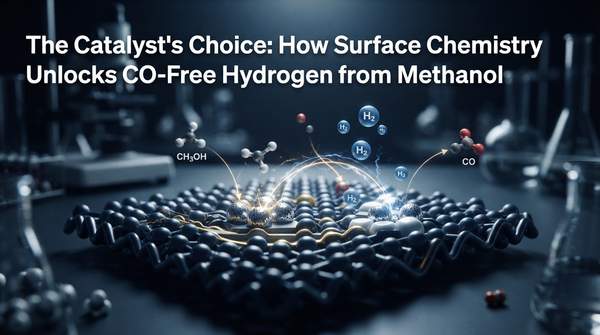
Methanol stands as a promising liquid carrier for hydrogen, offering a pathway to safer storage and transport for fuel cell applications. However, releasing this hydrogen efficiently and cleanly presents a significant chemical challenge. A common byproduct, carbon monoxide (CO), can poison the polymer electrolyte membrane fuel cells that rely on pure hydrogen. The solution lies in the intricate design of catalysts, where subtle changes to surface chemistry can steer the underlying reactions, favoring the production of clean hydrogen and carbon dioxide instead of the harmful CO.
Scientists are exploring two distinct strategies to achieve this control. One approach involves creating specific metal alloys, such as those with palladium, to alter the reaction pathway. Another focuses on engineering the catalyst's support structure, using materials rich in hydroxyl groups to guide the reaction on platinum surfaces. Both methods demonstrate how manipulating the atomic-scale environment where methanol breaks down is the key to unlocking its potential as a clean energy source.
The Problem of the Poisonous Byproduct
The process of extracting hydrogen from methanol, known as reforming, is not a single-step reaction. During methanol steam reforming (MSR), a prominent technology for producing hydrogen for fuel cells, the methanol molecule undergoes a series of transformations on the catalyst's surface. Research published in Nature Communications identifies formaldehyde as a critical intermediate in this process. According to the study, the decomposition of this formaldehyde is a primary route for the production of carbon monoxide. While this CO can later react with water in a subsequent step to form more hydrogen and carbon dioxide, an inefficient catalyst can allow CO to escape, compromising the purity of the hydrogen fuel.
Steering Reactions with Palladium Alloys
One strategy to prevent carbon monoxide formation focuses on the metallic catalyst itself. By creating alloys, researchers can fundamentally change how intermediates like formaldehyde behave on the surface. In systems using palladium-based catalysts, the goal is to guide the reaction away from the pathway that leads to CO. Instead of allowing formaldehyde to decompose into carbon monoxide and hydrogen, an engineered catalyst surface can promote a reaction that leads directly to carbon dioxide. This selective control over the reaction mechanism is crucial for producing hydrogen that is sufficiently pure for use in sensitive applications like polymer electrolyte membrane fuel cells.
The Critical Role of Surface Hydroxyl Groups
A different approach focuses not just on the metal catalyst, like platinum, but on the oxide material that supports it. Researchers from Tsinghua University found that the oxygen species on the surface of the support material directly influence how methanol is converted. Their work highlights the importance of surface hydroxyl groups—combinations of oxygen and hydrogen—in promoting clean hydrogen production.
"In particular, surface hydroxyl groups can provide the right oxygen chemistry to promote hydrogen production without trapping key intermediates too strongly," said Hui Zhou, the study's corresponding author. The team tested platinum catalysts on five different oxide supports and found that the one with aluminum oxide (Pt/Al₂O₃) delivered the strongest performance. At 250 °C, it achieved a hydrogen production rate of 846.9 μmol gPt⁻¹ s⁻¹ with a methanol reforming selectivity of 97.3%. This activity was nearly 2.5 times that of a catalyst on cerium oxide and 20 times greater than one on silicon dioxide under the same conditions, a difference the researchers attribute to the behavior of surface oxygen. The study concludes that hydroxyl-rich supports offer a particularly effective route for improving platinum-based catalysts.
Comparative Mechanisms for CO-Free Hydrogen Production
The strategies for producing clean hydrogen from methanol rely on manipulating distinct chemical pathways at the catalyst's surface. While both aim to avoid carbon monoxide, they achieve this through different means. The choice of catalyst system—from traditional palladium setups to engineered alloys or platinum on specialized supports—determines which reaction dominates, directly impacting the purity of the final hydrogen product.
| Catalyst System | Key Surface Property | Reaction Pathway | Primary Byproduct |
|---|---|---|---|
| Traditional Pd/ZnO | Standard metal-support interface | Methanol dehydrogenates to a formaldehyde intermediate, which can then decompose into carbon monoxide. | Carbon Monoxide (CO) |
| Engineered PdCu/ZnO | PdZn alloy formation | The alloyed surface alters the transformation of the formaldehyde intermediate, steering the reaction away from CO formation. | Carbon Dioxide (CO₂) |
| Pt/Al₂O₃ | High density of surface hydroxyl groups | Hydroxyl groups on the aluminum oxide support facilitate water activation, promoting a pathway that bypasses CO formation. | Carbon Dioxide (CO₂) |
Advancing Catalyst Design for Sustainable Hydrogen
The success of these distinct catalytic strategies underscores a unified principle: the key to clean hydrogen from methanol lies in precise control over the reaction environment at the atomic level. Whether through the rational design of metal alloys or the careful selection of hydroxyl-rich oxide supports, the goal is to steer the chemical transformation of methanol toward the production of carbon dioxide, effectively closing the door on the pathway that generates poisonous carbon monoxide. This focus on surface engineering provides clear direction for future research and development.
For scientists and engineers, the path forward involves a decision to focus catalyst development on engineering surface properties, such as alloy formation or hydroxyl group density, to steer methanol reforming towards CO₂ and away from CO. Progress in this field can be tracked by a clear measurable indicator: increased hydrogen selectivity and reduced CO byproduct in laboratory-scale methanol reforming experiments. These advancements are critical steps toward realizing methanol's potential as a safe and sustainable carrier for the hydrogen economy.
Sources
- Surface Oxygen Guides Hydrogen From Methanol Over Pt — Mirage News