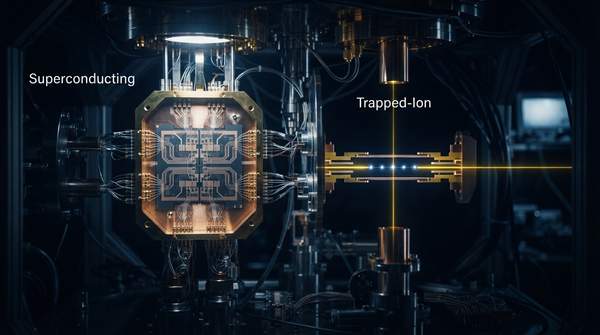
In the race to build a powerful quantum computer, superconducting circuits and trapped atomic ions have emerged as two of the most developed physical architectures. While both aim for the same computational goal, they are built on fundamentally different principles, leading to a distinct set of trade-offs in performance, operational requirements, and scalability. There is no single best approach; instead, the choice between them depends on the specific application, with superconducting qubits offering faster operations while trapped ions provide higher accuracy.
Superconducting qubits are artificial atoms, electrical circuits cooled to temperatures colder than deep space, while trapped-ion qubits use actual atoms—electrically charged ions suspended in electromagnetic fields. This physical difference is the source of their respective strengths and weaknesses. An experimental comparison of the two platforms, one using a superconducting transmon device and the other a trapped-ion system, highlights how these architectural choices influence everything from error rates to the complexity of running algorithms. Understanding these differences is crucial for navigating the landscape of quantum hardware.
Decision Framework: Superconducting vs. Trapped-Ion Qubits
To understand the practical implications of choosing one quantum architecture over another, it is essential to compare their core characteristics side-by-side. The following framework contrasts the two leading modalities across key operational and performance dimensions. This comparison reveals that superconducting systems excel in speed and manufacturing scale, but require extreme cooling and have fixed qubit connections. Conversely, trapped-ion systems provide superior fidelity and flexible connectivity at the cost of slower operations and complex laser-based controls.
| Characteristic | Superconducting Qubits | Trapped-Ion Qubits |
|---|---|---|
| Physical Form | Artificial atoms built from superconducting electrical circuits on a chip. | Individual atomic ions, which are real atoms, suspended by electromagnetic fields. |
| Operating Temperature | Requires extreme cryogenic cooling to approximately 15 millikelvin, near absolute zero. | The trap itself can operate at room temperature, though some cooling improves performance. Does not require costly millikelvin cryogenics. |
| Two-Qubit Gate Fidelity | An experimental device achieved a fidelity of 97.2(1)%. Error rates are generally higher but improving. | An experimental system achieved 99.2(1)% fidelity. Other analyses report fidelities as high as 99.91%, among the best available. |
| Scalability | Considered easier to scale in raw qubit count due to established chip-based manufacturing techniques. | Faces challenges in scaling due to the need for complex, stable, and often bulky laser systems to control each ion. |
| Connectivity | Typically has limited connectivity, such as interactions only between nearest-neighbor qubits on the chip. | Offers full all-to-all connectivity, allowing any qubit to interact directly with any other qubit in the system. |
The Core Trade-Off: Fidelity vs. Gate Speed
The most significant performance difference between the two architectures lies in the balance between accuracy and speed. Trapped-ion qubits are renowned for their high fidelity, a measure of how accurately a quantum operation is performed. One analysis reported a two-qubit gate fidelity for trapped ions at 99.91%, compared to 99.7% for a superconducting system. Mete Atatüre, head of the Cavendish Laboratory at the University of Cambridge, described trapped ions as offering "the cleanest, most beautiful qubits." This high fidelity means fewer errors accumulate during a computation, which is critical for running complex algorithms and may reduce the number of physical qubits needed to create a single, more robust "logical qubit."
In contrast, superconducting qubits operate much faster, with gate speeds measured in nanoseconds, while trapped-ion gates are in the microsecond to millisecond range. This speed advantage allows superconducting systems to perform more operations in a given amount of time, a key factor for near-term experiments and algorithms where execution time is a priority. The choice, therefore, depends on the problem: applications sensitive to errors benefit from the high fidelity of trapped ions, while those demanding rapid calculations may be better suited to the speed of superconducting systems.
Engineering the Future: Scalability and Connectivity
Scaling each technology to thousands or millions of qubits presents unique and formidable engineering challenges. For superconducting systems, the primary obstacle is the extreme environment they require. The circuits must be cooled in dilution refrigerators to around 15 millikelvin—a temperature colder than deep space—to maintain their quantum properties. While manufacturing the chips themselves leverages existing semiconductor fabrication techniques, managing the cooling and wiring for a large number of qubits becomes increasingly complex.
Trapped-ion systems avoid the need for such costly cryogenics but face their own hurdles. Controlling the ions requires a complex array of precisely aimed lasers, and maintaining this optical setup's stability as the number of ions grows is a significant challenge. Furthermore, while the ions themselves are excellent qubits, manipulating them can be difficult. As Atatüre noted, "Trapped ions are great to begin with, but moving them around is a challenge.” This physical constraint, along with the bulky nature of current laser systems, complicates scaling efforts.
Another critical architectural difference is connectivity. A study comparing the two platforms noted that its trapped-ion system had full connectivity, meaning any qubit could interact with any other. The superconducting device, however, had limited connectivity, such as nearest-neighbor couplings only. This distinction has major implications for programming, as full connectivity simplifies the process of mapping complex algorithms onto the hardware, whereas limited connectivity often requires additional, error-prone steps to move information between distant qubits.
Selecting a Qubit Architecture: Fidelity, Speed, and Engineering Realities
The ongoing development of quantum computers highlights that there may not be a single winning hardware approach. As one analysis from The Quantum Insider notes, "Different approaches could prove better suited to different applications." The decision between superconducting and trapped-ion architectures is a clear example of this principle in action. Each platform presents a distinct profile of advantages and limitations that align with different computational priorities.
Researchers and developers should select a qubit architecture by weighing the critical trade-offs between high fidelity (trapped-ions) for error-sensitive algorithms and fast gate operations (superconducting) for speed-critical applications, while also considering the distinct engineering challenges and scalability pathways of each. An organization prioritizing fault-tolerance and algorithm accuracy might favor the high-fidelity, fully connected nature of trapped ions. In contrast, a group focused on near-term experiments and rapid iteration might lean toward superconducting systems for their faster gate speeds and more mature manufacturing processes.
Ultimately, the choice of architecture for a quantum computing project will be signaled by the primary performance metric prioritized (e.g., error rate vs. computation time) and the specific engineering infrastructure available or feasible for development. The progress in both fields suggests a future where different types of quantum computers may coexist, each optimized for the specific tasks they are designed to solve.