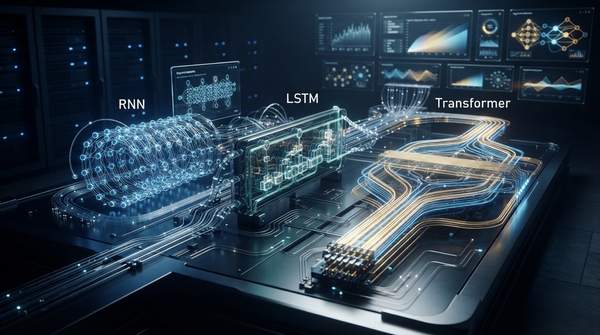
Choosing among recurrent neural networks (RNNs), Long Short-Term Memory (LSTM) networks, and Transformers comes down to one core question: does your task depend on long-range context, and can you afford sequential processing? RNNs, the earliest design built specifically for sequences, struggle with long inputs because of vanishing gradients and slow, step-by-step computation. LSTMs fix much of the memory problem with gated memory cells but remain sequential. Transformers discard recurrence entirely, using self-attention to process a whole sequence at once, which has made them the dominant architecture for many sequence tasks, particularly in natural language processing, while RNNs remain relevant where computational efficiency, real-time processing, or inherently sequential data matters.
The Challenge of Sequential Data: Understanding Recurrent Neural Networks (RNNs)
Sequences — sentences, speech, stock prices — pose a problem ordinary networks cannot handle: the meaning of each element depends on what came before it. RNNs were the first neural networks designed for sequential data, and their solution is elegantly simple. They maintain a hidden state that captures a memory of past inputs through a feedback loop, so each output depends on the previous inputs in the sequence.
This recurrent structure made RNNs well suited to tasks like sentiment analysis and speech recognition, where recent context carries much of the signal. But the same feedback loop that gives them memory also creates two serious weaknesses. First, the vanishing gradient problem means they struggle to learn long-term dependencies. Second, their memory is limited: as sequences grow longer, they gradually forget earlier information.
There is a third, practical constraint. Because each time step must wait for the previous one to finish, RNNs process data sequentially. That bottleneck prevents parallel computation across the sequence and slows training on long inputs. For short sequences this hardly matters; for long documents or long time series, it becomes a fundamental limitation on scale.