Neuromorphic computing achieves its energy efficiency not through faster chips but through a fundamentally different arrangement of memory and processing. Nearly every modern computer follows the Von Neumann design: a central processing unit that is physically separate from memory, with data constantly shuttling between the two. That round trip — the "Von Neumann bottleneck" — limits both speed and energy efficiency. Neuromorphic systems instead store and process information in the same place, in artificial neurons that consume power only when they fire, mirroring how the brain works. The result is an architecture purpose-built for low-power, low-latency AI tasks such as sensory processing and edge computing, rather than a universal replacement for conventional computers.
The Von Neumann Bottleneck: A Fundamental Challenge
Since the mid-1900s, computing has been carried out primarily on machines following the Von Neumann architecture, a design named after John von Neumann and dating back to his work on the ENIAC project during the Second World War, as an overview published in the Cognitive Science Student Journal recounts. The model is elegantly simple: a central processing unit executes instructions, a separate memory unit holds both data and programs, and a bus connects them. This separation has been the basis for nearly all modern computers.
The cost of that simplicity is structural. As IBM explains in its technical overview, most modern computers have separate central processing units and memory units, and the transfer of data between these units can cause a bottleneck that impacts speed. Every computation requires the processor to fetch data from memory, act on it, and write results back — a continuous movement that is a fundamental aspect of the machine's operation, not an occasional inefficiency.
The problem compounds as workloads grow. A U.S. Department of Energy roundtable report on neuromorphic computing noted that modern computation based on the Von Neumann architecture has allowed continuous improvements as predicted by Moore's law, but that computation using current architectures and materials will inevitably reach a limit for fundamental scientific reasons. Moving data costs energy and time regardless of how fast the processor itself runs, which is why adding transistors no longer translates proportionally into faster AI inference. The bottleneck is architectural, and fixing it requires changing the architecture.
Neuromorphic Computing: Brain-Inspired Architecture
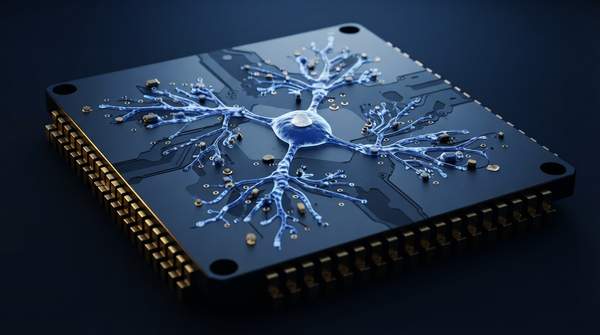
Neuromorphic computing takes the brain as its blueprint. A peer-reviewed survey of the field describes neuromorphic hardware as an innovative computing architecture that mimics the structure and function of biological nervous systems, aiming to achieve efficient, low-power information processing by replicating the behavior of neurons and synapses. Where the Von Neumann machine separates thinking from remembering, the brain does both in the same structures — and neuromorphic hardware follows suit.
The field is explicitly framed as a departure from conventional design. Unlike traditional computing architectures, neuromorphic hardware employs spike signals for spatiotemporal coding, incorporating simulated neural activity, event-based computing, a non-Von Neumann architecture, and memory processing. The interdisciplinary field seeks to develop hardware and software for energy-efficient, high-performance computing, with applications spanning neuroscience research, low-power edge intelligence, and data center acceleration.
Crucially, the memory-processing integration is what dissolves the bottleneck. IBM's overview notes that neuromorphic computing systems both store and process data in individual neurons, resulting in lower latency and swifter computation compared with Von Neumann architecture. There is no long commute for data because computation happens where the data lives. A 2022 demonstration made this concrete: the NeuRRAM chip, designed by a team led by Gert Cauwenberghs at UC San Diego, runs computations directly in memory and can run a wide variety of AI applications at a fraction of the energy consumed by platforms built for general-purpose AI computing — without compromising accuracy, as the university reported.