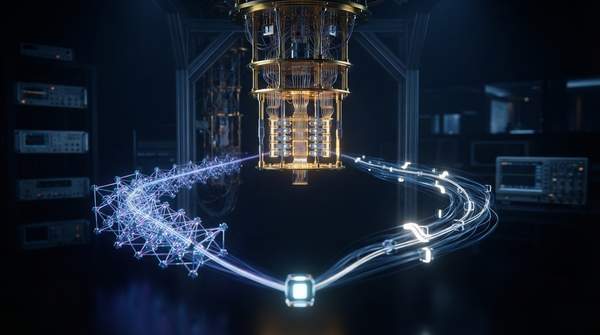
Fault-tolerant quantum computing has a scaling problem that sits at the heart of the field: quantum states are fragile, and correcting their errors consumes enormous hardware resources. Depending on the error-correction scheme and the underlying hardware error rates, building a single reliable logical qubit can demand somewhere between 100 and 10,000 physical qubits. Those estimates, while imprecise, define the central barrier to useful quantum machines — a machine that would otherwise need thousands of logical qubits balloons into one requiring millions of physical ones.
Two strategic responses have emerged. One optimizes the mathematics: quantum low-density parity-check (qLDPC) codes promise the same fault tolerance from a far smaller physical-qubit budget. The other optimizes the hardware itself: erasure qubits re-engineer the physical device so its most common failure becomes the easiest kind of error to correct. This article explains both mechanisms and compares their distinct philosophies.
Advanced Codes: Optimizing Software with qLDPC
The traditional workhorse of quantum error correction is the surface code, which arranges qubits on a two-dimensional lattice and repeatedly measures local check operators to detect errors. Surface codes are prized for their tolerance of noisy hardware, but they pay for that robustness with a low encoding rate: only a small fraction of the physical qubits in a surface-code patch contribute to the logical qubit being protected, so the physical-to-logical ratio grows steeply as a machine scales.
Quantum LDPC codes attack the problem at the level of code structure rather than qubit physics. By designing codes whose parity checks are sparse — each check involving only a few qubits — theorists can pack more logical qubits into the same physical footprint while preserving the distance properties that make error correction possible. According to The Quantum Insider, which surveyed recent progress in error-correction strategies, recent theoretical and experimental work suggests qLDPC codes could achieve fault tolerance with significantly fewer physical qubits per logical qubit than surface codes, potentially cutting resource requirements by an order of magnitude or more.
The claim has already moved beyond theory in at least one commercial case. Iceberg Quantum, a Sydney-based startup founded by University of Sydney researchers, unveiled its Pinnacle fault-tolerant architecture in February 2026. The company claims the design can reduce the physical qubits needed to break RSA-2048 encryption from more than a million to under 100,000 — a tenfold reduction under standard hardware assumptions. That figure is a company claim about a specific architecture, not a measured experimental result, and it depends explicitly on those stated assumptions. Even so, it illustrates why qLDPC has become one of the most closely watched directions in the field: the gains arrive by changing the code, not by demanding more from the qubits themselves.
The trade-off is conceptual as well as practical. qLDPC codes are more intricate mathematical objects than surface codes, and their advantages in encoding density must be weighed against the complexity of implementing their longer-range connectivity and decoding algorithms on real devices. The strategy's core principle, though, is simple to state: keep the hardware as it is, and make every physical qubit do more logical work.