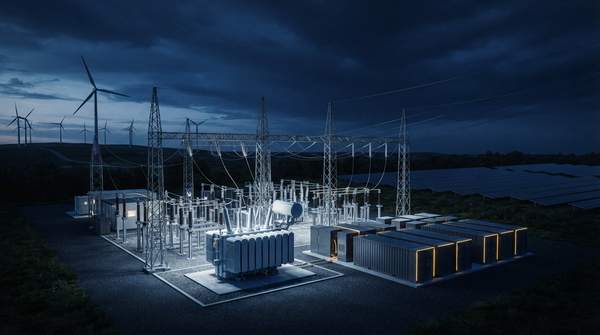
Wind and solar power challenge grid stability because their output fluctuates with weather, daylight, and season, and because the inverters that connect them to the network do not inherently provide the physical inertia that conventional power plants have long supplied for frequency regulation and voltage support. The engineering response is not a single fix but a set of distinct solution categories—energy storage, advanced power electronics, and grid-forming inverters—each mapped to a specific stability problem. This article explains the underlying electrical principles, traces how variable generation disrupts them, and presents a framework that connects each challenge to its corresponding engineering solution.
Understanding Grid Stability: The Foundation of Power Delivery
Grid stability rests on two pillars: keeping the system's frequency—50 or 60 hertz depending on the region—steady, and keeping voltage levels within the range that equipment is designed to tolerate. Deviations in frequency can damage equipment and, in severe cases, trigger blackouts; unstable voltage degrades power quality and can contribute to system collapse. For decades, both pillars were maintained almost automatically by the very machines that generated the power.
Conventional power plants, as an academic review of renewable integration challenges in the International Journal of Renewable Energy Sources explains, have long been relied upon for essential grid stability services such as frequency regulation and voltage support. These are known as ancillary services: functions that do not primarily deliver energy but keep the system balanced and operable. As those plants are gradually retired, the review notes, the need for alternative solutions becomes urgent. The stability functions they once provided do not disappear with them—they must be replaced by new technologies and strategies.