NASA's Perseverance rover carries a deliberately mismatched toolkit: a pair of zoomable cameras for panoramic context, a mast-mounted laser that reads rock chemistry from meters away, and two arm-mounted spectrometers that interrogate targets at the scale of a grain of salt. The four instruments—Mastcam-Z, SuperCam, PIXL and SHERLOC—do not duplicate one another. They operate at successively finer scales and with different analytical techniques, so that a single rock can be surveyed from a distance, zapped remotely, and finally mapped element by element and molecule by molecule before scientists decide whether it is worth caching for a future return to Earth.
Introduction to Perseverance's Scientific Toolkit
Perseverance's instruments are, in NASA's description, "state-of-the-art tools designed to acquire information about Martian geology, atmosphere, environmental conditions, and potential biosignatures." The mission's broader goals, as summarized by NASA's Jet Propulsion Laboratory, include identifying past environments capable of supporting microbial life, seeking signs of that past life, and collecting and storing rock and soil samples on the Martian surface. Compared with its predecessor Curiosity, the Mars 2020 rover was designed to focus on fine-grained mineralogy to help detect biosignatures and understand how ancient habitats changed over time, as The Planetary Society reported when the instruments were selected in 2014.
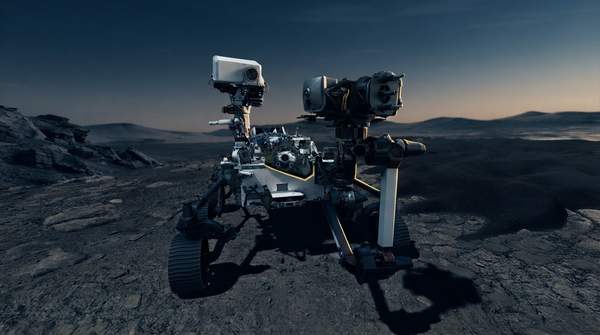
That emphasis on fine scale explains the payload's architecture. Two instruments sit on the remote-sensing mast: the Mastcam-Z imagers in gray boxes beneath the masthead, and SuperCam, whose lens occupies the large circular opening in the mast head. Two more ride on the robotic arm, placing them in direct contact—or near-contact—with rock. The division is not incidental; it defines the workflow scientists use to decide which rocks deserve the rover's most detailed attention.
Mastcam-Z: The Rover's Eyes for Context
Mastcam-Z is a pair of cameras on the rover's mast that simulate a pair of human-like eyes, with the addition of zoom capability, according to the U.S. Geological Survey's Astrogeology program, whose Ken Herkenhoff serves as co-investigator on the instrument's science team. Because there are two cameras, Mastcam-Z collects images in stereo, and those slightly offset pairs can be combined into high-resolution 3D images and models. It records red-green-blue color similar to human vision, but it can also use narrow-band filters to isolate specific wavelengths, including some in the near-infrared beyond what our eyes can see.
The USGS lists three primary goals for the investigation: understanding the overall landscape forms, processes and geology within the rover's view; supporting rover navigation and sample selection while providing context for the other Perseverance instruments; and collecting information about the Martian atmosphere and sky during both night and day. The multispectral capability matters scientifically—imaging in additional wavelengths can help scientists determine which minerals are present, which in turn helps them interpret the geological history of the area. In practice, Mastcam-Z is usually the first instrument to speak about a new target, framing everything that follows.
SuperCam: Remote Chemical and Mineral Analysis
Mounted on the mast alongside Mastcam-Z, SuperCam examines targets the rover may never drive to. NASA describes it as an upgraded version of Curiosity's ChemCam, and it is a multi-technique instrument: it fires a pulsed laser at rock and soil from a distance, and its suite of spectrometers analyzes what comes back. The instrument team, led by Roger C. Wiens and Sylvestre Maurice and publishing in Space Science Reviews in 2021, documents a system that combines laser-induced breakdown spectroscopy with Raman and visible/infrared spectroscopy.
The distinction matters for readers trying to tell the instruments apart. Laser-induced breakdown spectroscopy reads the flash of plasma from a vaporized spot to determine a rock's elemental composition; the Raman and infrared spectrometers extend that to mineralogy and the detection of organic compounds—all without the rover needing to position its arm. SuperCam therefore acts as a remote screening tool: it can survey many rocks quickly, flagging which ones carry interesting chemistry or mineralogy before the team commits time to a close-up encounter. NASA's instrument page shows the payoff in images such as the mosaic of the rock target "Yeehgo," assembled from SuperCam data.
PIXL: Micro-Scale Elemental Mapping
Where SuperCam works from the mast, PIXL—the Planetary Instrument for X-ray Lithochemistry—moves to the rover's robotic arm and shrinks the scale dramatically. PIXL is an X-ray fluorescence instrument that rapidly measures elemental chemistry at sub-millimeter scales, according to its developers at JPL, by focusing an X-ray beam to a tiny spot on the target rock or soil and analyzing the induced fluorescence. NASA's instrument description puts the resolution in human terms: PIXL's camera can see features as small as a grain of salt.
That fine scale is the point. Bulk chemistry can tell you what a rock is made of on average; sub-millimeter mapping reveals how elements are distributed within it—whether particular minerals sit in veins, nodules or layered bands that record how water moved through the rock. PIXL also carries a camera that takes super close-up pictures of rock and soil textures, pairing texture with composition. NASA states that together this information helps scientists look for signs of past microbial life on Mars, because potential biosignatures would likely be preserved as subtle chemical patterns at exactly the scales PIXL resolves.
SHERLOC: Organic Molecule and Mineral Detection
SHERLOC—the Scanning Habitable Environments with Raman & Luminescence for Organics & Chemicals—is also mounted on the end of the robotic arm, but it asks a different question than PIXL. NASA describes it as using cameras, spectrometers and a laser to search for organics and for minerals that have been altered by watery environments and may be signs of past microbial life. Where PIXL maps which chemical elements are present, SHERLOC specializes in detecting and characterizing organic molecules and specific minerals.
The Planetary Data System's Geosciences Node at Washington University in St. Louis summarizes SHERLOC's goals as assessing past aqueous history, detecting the presence and preservation of potential biosignatures, and supporting the selection of return samples—enabling "spatially resolved, high-sensitivity detection and characterization of organics and minerals" in the Martian surface and near subsurface. SHERLOC is assisted by WATSON, a color camera that takes close-up images of rock grains and surface textures, alongside its own black-and-white context camera. The pairing with PIXL is complementary by design: elemental maps from one and organic-mineral detections from the other converge on the same question of whether a rock recorded a habitable environment.
Perseverance Rover's Key Science Instruments: A Comparative Overview
The table below contrasts the four instruments across the dimensions that define their roles—where they sit, what they measure, how, at what range, and why. Read down the "Operational Scale" column and the multi-scale logic of the payload becomes visible: the rover moves from panoramic context to remote chemistry to contact-scale elemental and organic analysis.
| Instrument | Location on Rover | Primary Function | Analytical Technique | Operational Scale/Range | Key Scientific Goal |
|---|---|---|---|---|---|
| Mastcam-Z | Mast (two cameras) | Panoramic, stereo, zoomable color imaging; multispectral imaging | Visible and near-infrared imaging with narrow-band filters | Remote; broad landscape views down to zoomed detail on distant features | Geological context, navigation and sample selection support, atmospheric observations |
| SuperCam | Mast | Remote elemental, mineralogical and organic analysis of rock and soil | Laser-induced breakdown spectroscopy, Raman and visible/infrared spectroscopy | Remote; laser reaches targets at a distance without arm deployment | Rapid screening of many targets' chemistry and mineralogy |
| PIXL | Robotic arm | Fine-scale elemental composition mapping plus close-up texture imaging | X-ray fluorescence with a focused beam | Contact/close range; sub-millimeter, features as small as a grain of salt | Detect chemical patterns that may record past microbial life |
| SHERLOC | End of robotic arm | Detection of organics and water-altered minerals; close-up imaging via WATSON | Raman and luminescence (fluorescence) spectroscopy with a laser, plus cameras | Contact/close range; surface and near-subsurface, spatially resolved | Assess past aqueous history and potential biosignature preservation; support sample selection |
How the Instruments Work Together: A Multi-Scale Scientific Workflow
The instruments function as a sequence, and the sequence is the scientific method. Mastcam-Z first establishes context: what the landscape looks like, which outcrops and rocks stand out, and where the geology invites a closer look. SuperCam then screens candidate targets remotely, using its laser and spectrometers to determine elemental composition and mineralogy without the time cost of positioning the arm. Only targets that pass this screening earn a close-up encounter, when the arm deploys PIXL and SHERLOC against the rock itself.
At that final stage, the two arm instruments divide the labor: PIXL maps the distribution of chemical elements at sub-millimeter scales while SHERLOC hunts for organic molecules and minerals altered by water. The SHERLOC science team, writing in Space Science Reviews in 2021, described the payoff of this convergence: "This microscopic view of the organic geochemistry of a target at the Perseverance field site, when combined with the other instruments, such as Mastcam-Z, PIXL, and SuperCam, will enable unprecedented analysis of geological materials for both scientific research and determination of which samples to collect and cache for Mars sample return."
That closing phrase is the workflow's real product. Perseverance is a caching mission, and every instrument reading feeds a decision about which rock cores to store on the Martian surface. The Geosciences Node's summary makes the same point from the SHERLOC side: bearing the full suite of measurements down on a single sample lets the team assess the habitability of ancient environments and select high-priority samples for caching.
Coordinated Exploration: The Power of Perseverance's Integrated Instruments
To fully understand Martian geology and search for biosignatures, scientists must utilize the Perseverance rover's instruments in a coordinated, multi-scale sequence, moving from broad contextual imaging to remote chemical analysis, and finally to close-up elemental and organic detection. No single instrument could do this alone: Mastcam-Z sees but does not analyze chemically, SuperCam analyzes remotely but coarsely, and PIXL and SHERLOC resolve detail only where the arm can reach. The measurable indicator of success is the successful identification of a high-priority sample for caching, supported by a complete suite of data from all four instruments—context images, remote spectra, elemental maps and organic detections converging on the same rock before it is sealed for a potential journey home.
Sources
- Perseverance Science Instruments - NASA Science
- [Updated]: NASA Selects 7 Science Instruments for its Next Mars Rover — The Planetary Society
- Astrogeology has eyes on Mars through Mastcam-Z on Perseverance Rover — USGS
- The SuperCam Instrument Suite on the NASA Mars 2020 Rover — SpringerLink
- PIXL — Microdevices
- SHERLOC (Scanning Habitable Environments with Raman and Luminescence for Organics and Chemicals)
- Perseverance’s Scanning Habitable Environments with Raman and Luminescence for Organics and Chemicals… — OSTI