Choosing a deep-sea exploration vehicle comes down to one question: does your research need a scientist's eyes on the seafloor, a human hand on a manipulator arm in real time, or broad autonomous coverage of terrain no one can watch continuously? The three principal classes—human-occupied vehicles (HOVs), remotely operated vehicles (ROVs), and autonomous underwater vehicles (AUVs)—differ fundamentally in operational control, and those differences map directly onto what kind of data you can collect from abyssal ecosystems.
Understanding Deep-Sea Exploration Vehicles
NOAA's Ocean Exploration program, which uses all three classes on its supported missions, describes the essential distinction: HOVs carry a small team of scientists and pilots directly to the seafloor for a limited amount of time; ROVs are tethered robots piloted in real time from a surface ship; and AUVs operate untethered, following pre-programmed survey plans. All three share a basic toolkit—lights, cameras, sensors, and sampling instruments—but each class turns that toolkit toward a different scientific job.
The Woods Hole Oceanographic Institution (WHOI), a leading developer and operator of research submersibles, frames the modern spectrum as human-occupied submersibles, remote-controlled vehicles, autonomous robots, and towed systems. This article concentrates on the first three, comparing operational principles and typical applications rather than engineering specifications or costs.
Human-Occupied Vehicles (HOVs): Direct Observation and Interaction
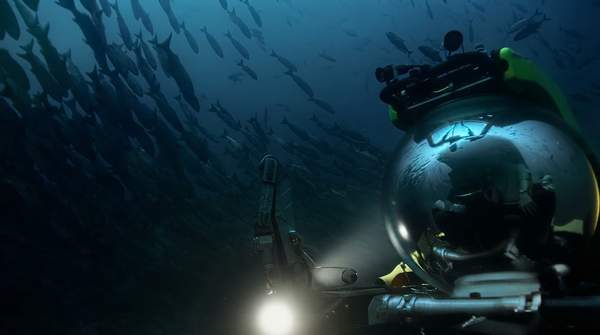
HOVs are unique in bringing what NOAA calls "scientist's own eyes and knowledge as deep as thousands of meters underwater to explore, observe, collect samples, and conduct research first-hand." That direct human presence enables immediate decision-making: a geologist can redirect attention to an unexpected outcrop, or a biologist can judge whether a specimen is worth collecting, in the moment. This makes HOVs especially suited for in-situ experimentation and precise sampling, with the trade-off of limited time on the seafloor per dive.
The canonical example is WHOI's Alvin, a three-person research submersible that, since its launch in 1964, has completed more than 5,100 dives and carried more than 3,100 scientists, engineers, and observers to the deep seafloor. Like other submersibles, Alvin carries lights, cameras, sensors, manipulator arms, and collection instruments—but its defining capability is the observer inside.
Remotely Operated Vehicles (ROVs): Precision and Extended Missions
ROVs trade human presence for endurance and precise remote control. As Blueye Robotics, an underwater vehicle manufacturer, explains, an ROV is a tethered underwater vehicle controlled in real time by an operator at the surface; the tether sends live video and data upward and carries control signals back down. That live connection lets operators react immediately to unexpected situations, inspect areas needing closer attention, or adjust the mission as conditions change.
WHOI's Jason/Medea system illustrates the scientific payoff: shipboard scientists guide Jason—a remote-controlled, deep-diving vehicle—as deep as 6,500 meters (4 miles) to explore underwater features on multi-day missions. Because operators remain safely aboard the support ship, ROVs can sustain far longer bottom time than crewed vehicles, combining high-definition visual surveys with manipulator work. NOAA's Deep Discoverer operates in this same role for deep ocean ecology observations and precise manipulation during exploration missions.
Autonomous Underwater Vehicles (AUVs): Mapping and Long-Term Monitoring
AUVs remove the tether and the pilot entirely. Operating from pre-programmed instructions, they are designed to cover large areas efficiently—work that would be impractical to supervise minute by minute in real time. According to NOAA, AUVs have been key players in ocean exploration since their development in the 1960s, and by the 1980s they were being specialized for deep-sea mapping. Their expansive applications have since produced a wide array of shapes and sizes.
WHOI's Sentry shows what a modern scientific AUV delivers. It is fully autonomous and capable of exploring the ocean down to 6,000 meters (19,685 feet), and its hydrodynamic shape allows faster ascents and descents. NOAA notes that Sentry "flies" above the seafloor with a built-in digital camera and multibeam echo sounder, surveying topographic features up to 6,000 meters underwater—precisely the broad-area coverage that HOVs and tethered ROVs cannot economically provide.
Comparative Overview of Deep-Sea Exploration Vehicles
The table below categorizes each class by its control method—manned, tethered, or autonomous—and aligns its primary advantage with the research objectives it serves best. Read it as a mission-planning reference: identify which control mode your objective demands, then match it to the corresponding vehicle type and example.
| Vehicle Type | Operational Control | Key Advantage | Typical Scientific Mission | Example Vehicle(s) |
|---|---|---|---|---|
| Human-Occupied Vehicle (HOV) | Carries scientists and pilots directly to the seafloor for a limited time | Firsthand observation, direct human presence, immediate decision-making | In-situ exploration, experimentation, and precise sample collection | WHOI's Alvin (3-person, diving since 1964) |
| Remotely Operated Vehicle (ROV) | Tethered robot controlled in real time from a support ship; tether carries live video, data, and control signals | Extended multi-day missions, high-definition visual surveys, precise manipulation—operators stay safely aboard | Real-time inspection, observation, data collection, and manipulation tasks | WHOI's Jason/Medea (to 6,500 m); NOAA's Deep Discoverer |
| Autonomous Underwater Vehicle (AUV) | Untethered, pre-programmed robot operating without real-time human control | Efficient broad-area coverage with faster transits via hydrodynamic design | Large-area deep-sea mapping and topographic survey | WHOI/NOAA's Sentry (to 6,000 m, with camera and multibeam echo sounder) |
Selecting the Optimal Deep-Sea Vehicle for Your Research
The choice of deep-sea exploration vehicle should be based on the specific research objective, weighing the need for direct human presence, real-time control, or autonomous large-area coverage. If your question depends on expert judgment in the moment—identifying a subtle biological interaction, choosing which specimen to collect—an HOV like Alvin is the match, accepting its limited bottom time. If you need sustained, manipulator-based work with live video feedback over multi-day missions at depth, an ROV such as Jason or Deep Discoverer fits, since its tether guarantees continuous control while the crew stays topside.
If your objective is mapping seafloor topography across wide areas or surveying terrain at depths to 6,000 meters without continuous supervision, an AUV like Sentry is the appropriate tool. The measurable indicator of a good selection is the mission's success in achieving its data collection goals—precise sampling, broad mapping, or in-situ experimentation—using the chosen vehicle type. Notably, these categories are not rigid: WHOI's operational spectrum also includes hybrid and towed robotic systems, and the lines between crewed, remotely controlled, and autonomous platforms continue to blur as the technology matures.
Sources
- Submersibles - NOAA Ocean Exploration
- Underwater Vehicles — Woods Hole Oceanographic Institution
- Autonomous Underwater Vehicles - NOAA Ocean Exploration