For most laboratory automation decisions, the answer comes down to one trade-off: workspace versus speed and rigidity. Serial manipulators give you a large, flexible work envelope suited to sample handling across benches and instruments; parallel manipulators trade that reach for stiffness, payload stability, and speed in a compact zone; and Delta robots—a specialized parallel design—push speed to extremes for light payloads. Here is how the three architectures compare and how to match each to your lab's tasks.
Understanding Robotic Manipulator Architectures for Lab Automation
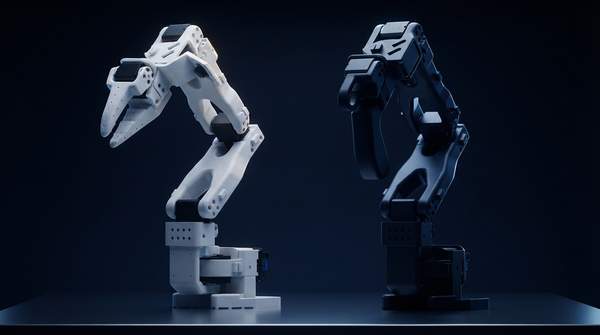
Robots are classified by their mechanical structure, and the two fundamental architectures differ in how joints and links are arranged. A serial manipulator is a single chain of links connected by joints, resembling a human arm; it is the most common industrial design. A parallel manipulator instead connects a fixed base to one moving platform through multiple arms or legs working together, forming a closed-loop structure.
That structural difference drives everything else. As Acrome Robotics' engineering overview explains, serial chains offer a large workspace, while parallel designs provide higher payload capacity, rigidity, and speed within a smaller workspace. The closed loop of a parallel robot distributes forces across multiple links rather than stacking them along one arm, which is why the two families occupy opposite corners of the reach-versus-stiffness trade-off.
Serial Manipulators: Flexibility and Reach
Serial manipulators, including most articulated industrial arms, are prized for large work envelopes and flexibility. Their jointed, arm-like structure lets them reach into tight spaces and perform complex maneuvers such as twisting and turning around obstacles—valuable in a crowded lab where a robot must service several instruments from one position.
On precision, Carl Murray's guide to manufacturing robots notes that many robots in this class achieve repeatability within a fraction of a millimeter, citing ±0.02 mm as an example of what quality-critical automation demands. Specific payload capacity varies greatly by model and size, from light lab arms to heavy industrial units. In research settings, Acrome reports serial manipulators handling tasks from sample handling and chemical mixing to DNA sequencing support and microscopic examination, and the same architecture underpins surgical systems like the Da Vinci, where precision and range of motion are critical.
Parallel Manipulators: Speed and Rigidity
General parallel manipulators, such as the Stewart platform, invert the serial design's strengths. By connecting multiple legs between base and platform, they gain incredible stiffness, speed, and precision—though, as Murray's overview puts it, often in a smaller workspace. Because forces are shared across links rather than cantilevered through a single chain, the architecture resists deflection under load.
That rigidity translates into higher payload capacity and greater stability compared to serial arms of comparable size, according to Acrome's comparison. For a lab, this suits tasks demanding high stiffness and precise force control in a compact volume—for example, fixturing, pressing, or micro-positioning applications where the end effector must hold position firmly under varying loads. The price is reach: everything happens within the dome or cylinder the legs can articulate around.
Delta Robots: High-Speed Pick-and-Place Specialists
Delta robots are a distinct type of parallel manipulator optimized for one job: extremely fast, light-payload pick-and-place. They use three or four kinematic chains to connect a fixed base to a lightweight moving platform, typically built from carbon fiber or aluminum alloy for high rigidity at minimal mass. The moving platform often weighs less than 1 kg.
The performance numbers are striking. GearKo Reducers' technical explainer reports that Delta robots achieve accelerations of 10G to 15G—far exceeding conventional robotic systems—with high-end cycle times as low as 0.25 seconds per pick-and-place operation. The trade-offs are payload, which stays light, and workspace, which is a smaller dome-shaped envelope. There is also an engineering caveat: maintaining accuracy at these speeds requires gearboxes with consistent torque transmission, minimal backlash, and high rigidity, since rapid directional changes place significant demands on drivetrain components.
Collaborative Robots (Cobots): Human-Robot Interaction in the Lab
Collaborative robots are kinematically serial manipulators—their single-chain, arm-like structure is the same as a traditional industrial robot's—but they are designed for direct interaction with people in shared workspaces. Acrome's overview lists cobots alongside other serial designs, and the distinction is operational rather than architectural: a cobot is built to work next to researchers rather than behind a fence.
University robotics facilities illustrate the pattern. The Maryland Robotics Center's manipulator lab stocks collaborative arms such as KUKA LBR iiwa, Sawyer, Baxter, and UR models, and describes manipulators that can be easily repositioned into different configurations for collaborative projects involving multiple robots, operating as a shared facility. For a lab where staff and automation share bench space and tasks change frequently, that repositionable, human-adjacent character is the practical draw.
Robotic Manipulator Selection Framework for Laboratory Automation
The table below compares the architectures across the axes that matter for lab selection. Reading it row by row reveals the core pattern: as you move from serial to parallel to Delta, workspace shrinks while stiffness and speed rise, with payload peaking in general parallel designs and speed peaking in Deltas.
| Manipulator Type | Kinematic Structure | Typical Payload Profile | Speed & Precision Profile | Workspace Characteristics | Common Lab Applications |
|---|---|---|---|---|---|
| Serial (incl. articulated arms and cobots) | Single chain of links and joints, like a human arm; most common industrial design | Varies greatly by model and size, from light to heavy payloads | Repeatability within a fraction of a millimeter (e.g., ±0.02 mm reported for manufacturing robots); precision balanced against complex multi-axis motion | Large work envelope; can reach into tight spaces and maneuver around obstacles | Sample handling, chemical mixing, DNA sequencing support, microscopic examination; shared-space collaborative work (cobots) |
| Parallel (general, e.g., Stewart platform) | Multiple arms or legs connecting base to a single moving platform in a closed loop | Higher payload capacity and stability than comparable serial arms, due to inherent rigidity | High stiffness, speed, and precision from force distribution across links | Smaller workspace than serial designs | Tasks needing high rigidity and precise positioning under load in a compact volume |
| Delta (specialized parallel) | Three or four kinematic chains from fixed base to a lightweight platform, often carbon fiber or aluminum | Light payloads; moving platform often under 1 kg | Acceleration of 10G–15G; cycle times as low as 0.25 seconds; precision maintained only with low-backlash, rigid gear systems | Smaller, dome-shaped envelope; speed and precision prioritized over reach | High-throughput, repetitive pick-and-place of light items, such as screening workflows |
Matching Robot Characteristics to Lab Tasks
Turn the table into a decision by starting with your task's binding constraint. If your constraint is coverage—moving samples between benches, instruments, and storage spread across a bench—serial manipulators are the natural fit, since their large envelope and maneuverability let one arm service an entire workflow. Cobots add the ability to do this alongside people in a shared lab.
If your constraint is throughput on light items, the Delta robot's 0.25-second cycle times and 10G–15G acceleration make it the specialist for high-throughput screening-style pick-and-place, provided every target position fits inside its dome-shaped workspace. If your constraint is rigidity—holding or applying force precisely in a small area—a general parallel manipulator's closed-loop stiffness and payload stability serve better than a serial arm. One caution applies across all three: the evidence here covers architectural types, not specific commercial models, and excludes cost, software ecosystems, and end-effector selection, so those factors need separate evaluation.
Making the Right Choice for Your Lab
Select the robotic manipulator type whose core trade-offs in workspace, payload, speed, and precision align most closely with the specific demands of your laboratory automation task. The evidence supports a clear mapping: serial arms for reach and flexibility, general parallel designs for rigidity and payload in compact zones, and Deltas for maximum speed on light payloads.
The measurable indicator of a correct choice is that the chosen robot type consistently performs the automated task within your specified throughput, precision, and workspace coverage requirements. Before committing, verify the two numbers the architecture alone cannot guarantee: whether your heaviest item and farthest target position fall inside the selected type's payload and envelope limits, and whether its repeatability meets the tolerance your assay or measurement actually requires.