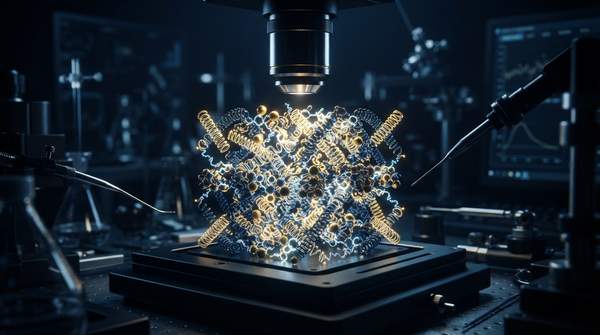
At the nanoscale, materials can spontaneously organize themselves from a collection of disordered building blocks into complex, functional structures. This process, known as self-assembly, is a fundamental strategy for designing and fabricating advanced materials. Driven by the mutual interactions between these tiny components, self-assembly is being harnessed by scientists to create novel materials with tunable properties for applications in fields ranging from medicine to energy.
The Core Principles of Nanomaterial Self-Assembly
Self-assembly is a process where a system of materials moves spontaneously toward a more ordered or organized state. Unlike traditional "top-down" manufacturing, this "bottom-up" approach relies on the inherent chemical and physical properties of the building blocks themselves. A key aspect of nanomaterials is that their characteristics can be precisely controlled by altering their size and shape. According to the U.S. Department of Energy, gold nanoparticles, for example, scatter light effectively, a property not seen in a larger chunk of gold, making them useful in electron microscopy.
The interactions that guide this process are often weak and non-covalent, such as hydrogen bonds or hydrophobic interactions. One of the most powerful examples is seen in amphiphiles—molecules that possess both a water-loving (hydrophilic) part and a water-fearing (lipophilic or hydrophobic) part. In a water-based environment, these molecules arrange themselves to minimize the exposure of their hydrophobic sections to water, leading to the formation of stable, ordered structures.
The final shape of these structures can be predicted using a concept known as the packing parameter. This calculation relates the volume of the hydrophilic head of the molecule to the volume and length of its lipophilic tail. By adjusting this ratio, scientists can guide the self-assembly process to form specific morphologies, such as spherical containers, worm-like tubes, or flat sheets.