Most smart material selections are decided before a single datasheet is opened — by the stimulus. A design that must react to heat points toward shape memory alloys; one that must sense pressure or move under voltage points toward piezoelectrics; a magnetic field points toward magnetorheological fluids; and a chemical environment such as shifting pH points toward stimuli-responsive polymers. That mapping, from stimulus to material family, is the core of a comparative analysis published in the International Journal of Research and Scientific Innovation, and it holds across biomedical, aerospace, and sensing applications. This guide turns that comparison into a working selection matrix, then adds a stimulus-first decision framework for the preliminary stage of adaptive system design.
Overview of Major Smart Material Classes
Smart materials sense and respond to external stimuli — chemical, electrical, mechanical, or magnetic signals — or to environmental circumstances such as temperature, illuminance, acidity, or humidity, according to an encyclopedia entry adapted from a peer-reviewed paper by Gabriele Bocchetta and colleagues. That dual role, sensing and acting within the material itself, is what makes them attractive platforms for adaptive systems, particularly as biomedical technologies progress.
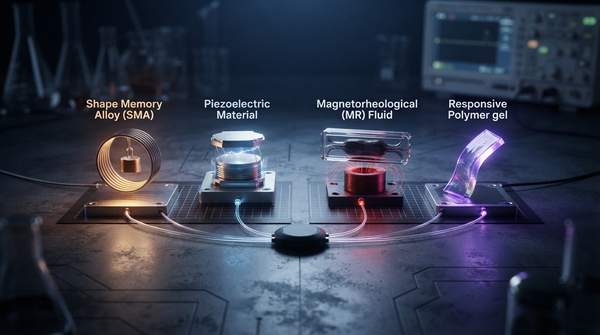
Four classes dominate preliminary selection. Shape memory alloys recover a trained shape when heated, through a reversible transformation between martensite and austenite phases that also yields superelasticity. Piezoelectric materials convert mechanical energy into electrical energy and vice versa — changing shape in response to an electrical impulse, or producing an electrical charge in response to applied mechanical stress, as Iberdrola's innovation primer describes. Magnetorheological fluids alter their flow behavior under a magnetic field. Stimuli-responsive polymers rearrange at the molecular level, swelling or contracting in response to temperature, pH, light, or chemicals.
The journal's comparison also tabulates two adjacent classes: magnetostrictive materials, which change dimensions under magnetic fields and serve sonar systems and vibration control, and electrochromic materials, which shift optical properties under electric fields in smart windows and displays. Useful as they are, the four classes at the center of this guide answer the most common adaptive design briefs.
Smart Material Selection Matrix
The matrix below cross-references each class's activation stimulus, response mechanism, key properties, and typical applications, drawn from the journal's comparative analysis. To use it, locate the stimulus your system will encounter, then read across the row to confirm that the response mechanism and application domain match your design intent — the cross-referencing step that narrows a field of candidates to one or two families.
| Smart Material Class | Activation Stimulus | Response Mechanism | Key Properties | Typical Applications |
|---|---|---|---|---|
| Shape Memory Alloys (SMAs) | Temperature (primary; stress can also induce the transformation) | Reversible phase transformation between martensite and austenite phases | Shape recovery, superelasticity | Biomedical stents, actuators, aerospace structures |
| Piezoelectric Materials | Mechanical stress or electric field | Electromechanical coupling producing electrical charge | High sensitivity, energy conversion capability | Sensors, ultrasound imaging, energy harvesting |
| Magnetorheological (MR) Fluids | Magnetic field | Change in rheological (flow) behavior under the applied field | — | Adaptive dampers |
| Stimuli-Responsive Polymers | Temperature, pH, light, chemicals | Molecular rearrangement leading to swelling or contraction | Flexibility, biocompatibility | Drug delivery systems, biosensors |
One row carries a caveat. The journal's table does not tabulate magnetorheological fluids, so their row here rests on the stimulus-first selection framework — which pairs magnetic-stimulus damping duty with an MR fluid — and on their defining field-responsive flow behavior. Their key-properties cell is left open rather than filled by guesswork, a gap to close with a material data sheet once an MR fluid becomes the candidate.
The Stimulus-First Selection Framework
A materials selection guide aligned with the methodology in Ashby's Materials Selection in Mechanical Design frames the choice as a ten-criterion exercise in "balancing multiple competing requirements simultaneously" — and its first criterion does most of the narrowing. Before properties, processing, or anything else, the engineer asks: is the stimulus mechanical, thermal, electrical, magnetic, optical, or chemical? "The stimulus type immediately narrows the material family," the guide states. "A pressure sensor requires a piezoelectric; a temperature-activated actuator requires an SMA; an adaptive damper requires an MR fluid."
The remaining criteria then discriminate within the family the stimulus has chosen. The guide stresses that understanding these functional properties is essential both for designing smart material systems and for comparing candidates during selection — which is precisely what the matrix above is for. A thermal brief pointing to an SMA can shift toward a stimuli-responsive polymer when the operating environment adds chemical cues such as pH, since polymers answer temperature and chemical signals alike; the framework, not the material name alone, tells you which requirement is doing the deciding.
Applying the Framework: Case Examples
A temperature-activated actuator. The stimulus is thermal, so the framework points to a shape memory alloy. The martensite-to-austenite transformation delivers shape recovery and superelasticity — the properties behind the journal's listed uses in biomedical stents, actuators, and aerospace structures. One qualification matters at the boundary: stress can also induce the phase transformation, but temperature remains the primary activation for shape recovery, so a heavily loaded design must keep the two effects deliberately separated.
A pressure sensor or energy harvester. The stimulus is mechanical stress, which points to a piezoelectric. The electromechanical coupling produces an electrical charge under pressure, and the same coupling runs in reverse — the material changes shape under an electrical impulse — so a single class serves both the sensing and the actuating side of a design. High sensitivity and energy conversion capability place piezoelectrics in sensors, ultrasound imaging, and energy harvesting.
An adaptive damper and a drug-delivery platform. A damping system driven by a magnetic field points, in the framework's words, to an MR fluid. A delivery system whose stimulus is chemical — pH in the body, for instance — points to stimuli-responsive polymers, whose molecular rearrangement and swelling or contraction, together with flexibility and biocompatibility, match the drug-delivery and biosensor applications in the journal's table.
Conclusion: Making Informed Material Choices
The pattern across all four classes is the same: the stimulus picks the family, and the response mechanism picks the application. Temperature selects SMAs for shape recovery in stents, actuators, and deployable aerospace structures; mechanical stress or electric fields select piezoelectrics for sensing, imaging, and harvesting; a magnetic field selects MR fluids for adaptive damping; and temperature, pH, light, or chemical cues select responsive polymers for biomedical platforms.
Keep the boundaries of this comparison in view. It covers the major classes, not every subtype or newly developed material; it omits chemical synthesis and manufacturing processes; and it offers no quantitative cost comparison between material types. Above all, it is a preliminary screen. The selection framework itself is explicit that choosing a smart material means balancing multiple competing requirements, and nothing here replaces detailed engineering analysis or consultation of a specific material's data sheet once a class has been chosen.
Decision Point: Matching Stimulus to Material
For preliminary smart material selection, prioritize identifying the primary external stimulus your adaptive system will encounter, then match it to the material class designed to respond to that specific input. The check that this step has actually happened is simple: the design specification clearly states the primary environmental or operational stimulus (e.g., temperature, mechanical force, magnetic field) that the adaptive system must respond to. Once that line exists, the matrix converts it into a candidate class — and the next milestone is confirming that candidate against its data sheet and the framework's remaining criteria.