SHERLOCK and DETECTR are two foundational CRISPR-based diagnostic platforms that differ at their core molecular machinery: SHERLOCK uses the enzyme Cas13, which natively targets RNA, while DETECTR uses Cas12a, which natively targets DNA. Both convert a pathogen's genetic material into a visible signal through the same clever trick—collateral cleavage of reporter molecules—but they differ in the enzyme, the target nucleic acid, and the reporter chemistry that produces the readout. Understanding those differences is the key to choosing the right platform for a given pathogen detection application.
The SHERLOCK System: Cas13 and RNA Detection
SHERLOCK—short for Specific High Sensitivity Enzymatic Reporter UnLOCKING—was developed in the lab of Feng Zhang at the Broad Institute and MIT. Its engine is Cas13, an enzyme first identified in 2016 as an RNA-guided RNase, as described by Addgene's scientific blog. A single CRISPR RNA (crRNA) guides Cas13 to a complementary RNA sequence; once the enzyme finds and binds its matching target, it activates a promiscuous RNase activity that cleaves not only the target but any nearby single-stranded RNA molecules.
The platform exploits that promiscuity. Researchers introduce synthetic RNA reporters into the reaction; when Cas13 locks onto its target, it shreds these bystander RNA reporters, releasing a measurable signal. According to a tabulated review of CRISPR-Cas diagnostic tools, the original SHERLOCK assay pairs the LwCas13a enzyme with recombinase polymerase amplification (RPA) and fluorescence detection, targeting viruses and bacteria with single-nucleotide specificity and a reported sensitivity of roughly 2 × 10⁻¹⁸ molar, in a process taking two to five hours.
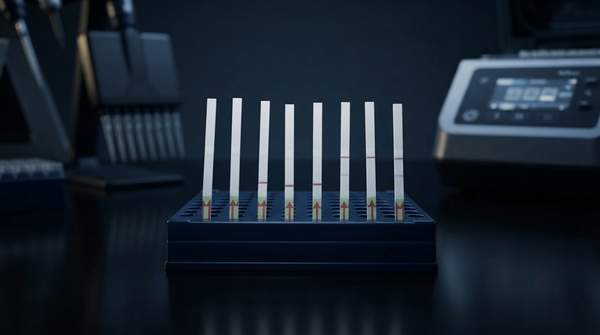
The Zhang lab later refined the tool for field use. As reported by the Association for Diagnostics & Laboratory Medicine, the team adapted the readout to a paper strip resembling a pregnancy test: users dip the strip into a processed sample and watch for a line to appear. "The new paper readout for SHERLOCK lets you see whether your target was present in the sample, without instrumentation," said co-first author Jonathan Gootenberg. A later version combined multiple Cas13 enzymes with Cas12a to sense several targets—such as dengue and Zika virus—in a single reaction, and paired Cas13 with the enzyme Csm6 to boost sensitivity threefold.
The DETECTR System: Cas12a and DNA Detection
DETECTR—the DNA Endonuclease Targeted CRISPR Trans Reporter—takes the same collateral-cleavage concept and rebuilds it around DNA. Developed in Jennifer Doudna's lab at UC Berkeley, the platform combines Cas12a, its guide RNA, a fluorescent reporter molecule, and recombinase polymerase amplification into a single reaction. Cas12a is an RNA-guided DNA endonuclease: its crRNA directs it to a specific DNA sequence rather than RNA.
The mechanism, as described by UC Berkeley, is direct: "When warmed to body temperature, RPA rapidly multiplies the number of copies of the target DNA, boosting the chances Cas12a will find one of them, bind and unleash single-strand DNA cutting, resulting in a fluorescent readout." In other words, once Cas12a binds its target DNA, it activates a collateral DNase activity that cleaves bystander single-stranded DNA reporters, generating fluorescence proportional to target presence.
The platform's proof of concept came with human papillomavirus. Applied to patient samples, DETECTR successfully distinguished between HPV types 16 and 18, a discrimination the study's authors cited as evidence of the test's sensitivity and precision. The tabulated review lists the DETECTR assay as using LbCas12a with RPA and fluorescence detection, targeting DNA with roughly six-nucleotide specificity, a reported sensitivity of about 10⁻¹⁸ molar, and a two-hour workflow. Study author Janice Chen framed the ambition broadly: the technology is "potentially applicable in any point-of-care diagnostic situation where there is a DNA component, including cancer and infectious disease."
Shared Principles: Amplification and Collateral Cleavage
Despite their different enzymes, the two platforms rest on the same operational logic. Both begin with isothermal amplification—typically RPA, which works at a constant temperature rather than the thermal cycling PCR requires—so that scarce pathogen nucleic acid is copied to a level the Cas enzyme can reliably find. As a Nature Biomedical Engineering review by Kaminski, Abudayyeh, Gootenberg, Zhang, and Collins notes, the CRISPR diagnostics toolbox is built around assays, preamplification strategies, and readouts working in concert.
The second shared principle is collateral cleavage. As Addgene's blog explains, both systems "harness the promiscuous cleavage and degradation of neighboring ssRNA and ssDNA by Cas13 and Cas12a, respectively, to cleave and activate a reporter." The detectable signal from that reporter can be measured and quantified to determine the presence and quantity of DNA, RNA, or a mutation of interest. This shared architecture is what makes both platforms attractive for point-of-care testing: no thermocycler, and in SHERLOCK's paper-strip format, no instrumentation at all.
Comparative Mechanisms: SHERLOCK vs. DETECTR
Juxtaposing the core functional components of each system reveals their fundamental mechanistic divergence. The table below contrasts the enzyme, target, and reporter chemistry of each platform, providing a decision framework that lets a user match the platform to the nucleic acid type of their pathogen of interest.
| Characteristic | SHERLOCK System | DETECTR System |
|---|---|---|
| Primary Cas enzyme | Cas13 (e.g., LwCas13a), an RNA-guided RNase | Cas12a (e.g., LbCas12a), an RNA-guided DNA endonuclease |
| Target nucleic acid | RNA (viruses, bacteria listed as targets) | DNA (demonstrated with HPV 16/18) |
| Collateral cleavage target | Bystander single-stranded RNA reporters | Bystander single-stranded DNA reporters |
| Amplification method | RPA (isothermal) | RPA (isothermal) |
| Reported readout | Fluorescence; later paper-strip lateral flow | Fluorescence |
| Reported sensitivity | 2 × 10⁻¹⁸ M (original assay) | 10⁻¹⁸ M |
| Reported time | 2–5 hours (original assay) | 2 hours |
The comparison makes the divergence visible: the enzymes dictate everything downstream. Cas13's native RNA targeting means SHERLOCK's collateral activity destroys RNA reporters; Cas12a's native DNA targeting means DETECTR's collateral activity destroys ssDNA reporters. Both use the same amplification backbone, so the practical choice reduces largely to the chemistry of the target.
Choosing the Right Platform for Pathogen Detection
For a specific application, the first question is the nature of the pathogen's genome. A DNA virus or a bacterium whose diagnostic signature is genomic DNA aligns naturally with DETECTR's Cas12a machinery, as demonstrated in the HPV work. RNA targets align naturally with SHERLOCK's Cas13. This distinction is based on the native target preference of the Cas enzymes, though the platforms' developers have extended each tool's reach—the SHERLOCK team, for instance, demonstrated detection of cancer mutations in cell-free DNA from saliva samples.
Secondary considerations follow from the published performance characteristics. The tabulated review reports comparable sensitivity for the foundational assays, with DETECTR's two-hour workflow at the faster end of SHERLOCK's two-to-five-hour range, and SHERLOCK offering single-nucleotide specificity against DETECTR's roughly six-nucleotide resolution. SHERLOCK's paper-strip readout, requiring no instrumentation, is a meaningful advantage in outbreak and resource-limited settings, while DETECTR's single-reaction format was designed from the outset for point-of-care DNA detection. These metrics come from published studies and may vary in real-world clinical use.
Two caveats bound this guidance. This comparison addresses the foundational SHERLOCK and DETECTR technologies, not every commercial product or later "version 2.0" iteration, such as the multi-enzyme SHERLOCKv2 that added Cas12a and Csm6 to the original Cas13 core. And neither platform is endorsed here for any specific medical diagnosis—the choice of a clinical diagnostic requires validation and regulatory review beyond a mechanistic match.
Informing Your Diagnostic Platform Choice
Researchers and clinicians should select between SHERLOCK and DETECTR based on the specific nucleic acid type (RNA or DNA) of the pathogen they intend to detect. The reasoning path is straightforward: identify the target's nucleic acid chemistry, match it to the enzyme with the corresponding native specificity—Cas13 for RNA, Cas12a for DNA—then weigh readout format and reported speed against the constraints of the deployment setting. The measurable indicator of a successful choice is successful detection of the target pathogen's nucleic acid using the chosen CRISPR system, indicated by a clear signal from the reporter molecule, whether that is fluorescence in the DETECTR reaction or a visible line on SHERLOCK's paper strip.