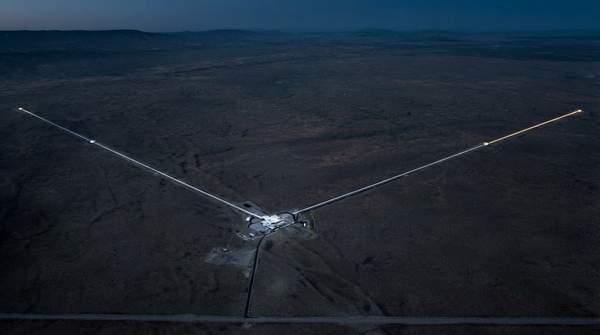
LIGO detects gravitational waves by using laser interferometry to measure a change in the relative lengths of two perpendicular 4-kilometer arms—a change so small it is on the order of a fraction of a proton's diameter. A passing gravitational wave distorts spacetime, altering the travel time of laser light in each arm and producing a phase difference that appears as a shift in the interference pattern when the beams recombine. The measurement is only possible because LIGO's mirrors are shielded from terrestrial vibrations, which are millions of times larger than the signal, by a two-tiered system of passive pendulum suspensions and active seismic cancellation.
Detecting Cosmic Ripples: An Introduction to Gravitational Waves and LIGO
Gravitational waves are tiny distortions of spacetime produced by astronomical events, and a gravitational-wave detector is any device designed to measure them. Since the 1960s, detector designs have steadily improved, and the present generation of laser interferometers has reached the sensitivity needed to detect waves from astronomical sources, making them the primary tool of gravitational-wave astronomy. The most sensitive ground-based laser interferometer is LIGO, the Laser Interferometer Gravitational Wave Observatory, the site of the first confirmed detections in 2015. Interferometric detectors measure gravitational-wave-induced motion between separated "free" masses, which allows the masses to be placed far apart—increasing the signal size—and makes the instrument sensitive to a wide range of frequencies rather than only those near a resonance.