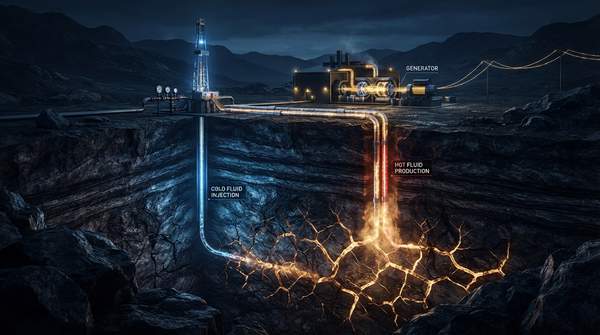
An enhanced geothermal system (EGS) works by doing something the underground cannot do on its own: it manufactures a reservoir. Fluid is injected deep into hot rock that lacks natural permeability, fracturing the rock and re-opening old cracks until a human-made heat exchanger forms underground. Once that network exists, cool fluid pumped down one well returns up another as hot fluid, and that heat becomes electricity on the surface. Understanding each stage of that sequence—and especially the fracturing choices that shape the reservoir—is the key to assessing why EGS is technically demanding and where innovation is heading.
Understanding Enhanced Geothermal Systems (EGS)
The Earth's heat is, in principle, nearly everywhere: as Berkeley Lab's news center puts it, there is a substantial amount of heat in subsurface rock essentially everywhere, but not all rock is permeable enough to allow fluid to flow through it. Conventional geothermal plants need naturally permeable, water-bearing formations, which are geographically rare. EGS removes that constraint by enhancing rock permeability artificially, opening access to what Berkeley Lab describes as a near-ubiquitous source of around-the-clock energy.
The U.S. Department of Energy frames the technology in the same terms: where hot rock exists but cannot be tapped conventionally, an EGS "creates a human-made reservoir to tap that heat for energy." That engineered reservoir is the entire game, and every stage of the process—from drilling to generation—exists to build and exploit it. The Energy Department's Enhanced Geothermal Shot analysis suggests the domestic resource could exceed 90 gigawatts of electric capacity, enough to power the equivalent of more than 65 million homes.
The Enhanced Geothermal System Lifecycle
The table below traces the full sequence, pairing each physical action with the engineering objective it serves. Each row builds on the one before it: without access, no stimulation; without stimulation, no circulation; without circulation, no heat to convert.
| Stage | Physical Action | Engineering Goal |
|---|---|---|
| Well drilling | Deep wells are drilled through hard, hot, impermeable rock | Establish physical access to the underground heat source |
| Reservoir stimulation | Fluid is injected under carefully controlled conditions to create new fractures and re-open pre-existing ones | Manufacture permeability, forming a fracture network the rock does not naturally have |
| Fluid circulation | Cool fluid is pumped down an injection well and drawn through the fractured hot rock toward a production well | Transfer the rock's stored heat to the working fluid |
| Surface conversion | Hot fluid is pumped to the surface | Convert the recovered thermal energy into electricity for the grid |
The model makes clear that reservoir stimulation is the pivotal stage: it is the only step in which the rock itself is deliberately altered, and every downstream gain in heat extraction depends on how well that stage succeeds.
Step 1: Drilling the Geothermal Wells
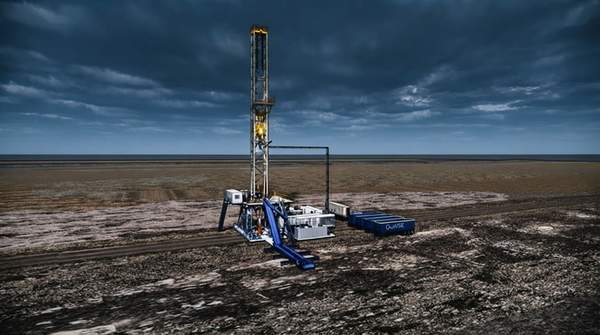
Everything begins with reaching the resource. As Princeton Engineering's reporting explains, enhanced geothermal involves drilling deep underground through hard, hot, and impermeable rock to form an underground reservoir. The hardness of that rock cuts both ways: it is what traps the heat in place, and it is what makes the wells difficult and expensive to drill. The Energy Department notes that advances borrowed from the oil and gas industry—in drilling and well construction, and through co-production possibilities in existing oil and gas basins—have created new opportunities for geothermal expansion.
At least two wells are required for the system to function: one through which cool fluid enters the reservoir, and one through which it is extracted as hot fluid, as Princeton's description of an injection well and a production well makes clear. The well placement defines the geometry of the heat exchanger that stimulation will complete.
Step 2: Reservoir Stimulation – Creating Permeability
This is the stage that defines EGS as a technology. In the Energy Department's description, fluid is injected deep underground under carefully controlled conditions to create new fractures and cause pre-existing fractures to re-open, creating permeability. The precision of that wording matters: the operator is not simply cracking rock at random but tuning pressure, rate, and fluid to grow a connected network rather than a single channel.
The engineering objective is controlled flow, not just flow. The Energy Department's Office of Geothermal supports technologies and techniques to control fluid flow within the fracture network in EGS reservoirs in order to optimize them for heat extraction. In other words, a fracture network is only as valuable as the degree to which fluid can be steered through it, contacting hot rock across as much surface area as possible for as long as possible.
Conventional Hydraulic Fracturing vs. Cyclic Liquid Nitrogen Fracturing
How the fractures are created shapes what the reservoir becomes. The standard approach, conventional hydraulic fracturing, pumps fluid into dry hot rock under pressure. But a 2023 technical review of fracturing and thermal extraction optimization methods in EGS, published in Advances in Geo-Energy Research, identifies a limitation: conventional hydraulic fracturing in dry hot rock reservoirs typically requires high breakdown pressure and only produces a single major fracture morphology.
A single dominant fracture is a poor heat exchanger. It gives circulating fluid one narrow path and a limited contact area, so heat is extracted quickly near the inlet while the surrounding rock goes unused. That is why, in the review authors' assessment, it is imperative to explore better fracturing methods. Their proposed alternative is cyclic fracturing using liquid nitrogen instead of water, which they report can generate more complex fracture networks and improve fracturing performance.
The trade-off is fundamental: water-based fracturing is mature and field-proven, while cyclic liquid nitrogen fracturing is an emerging method whose appeal lies in fracture complexity. For EGS specifically, complexity is the metric that matters, because a denser, more interconnected network distributes flow, maximizes rock-to-fluid contact, and sustains heat extraction over the reservoir's life.
Step 3: Fluid Circulation and Heat Exchange
Once the reservoir exists, the system becomes a closed loop through engineered geology. Cool fluid is pumped into the reservoir at one well and extracted as hot fluid from another, as Princeton's reporting describes. Permeability is what allows that loop to function: in the Energy Department's phrasing, increased permeability allows fluid to circulate throughout the fractured hot rock, and the fluid becomes hot as it circulates.
The heat exchange itself is conduction into advection. Heat stored in the rock conducts across the fracture faces into the flowing fluid, which carries it toward the production well. The rate of that transfer depends on the fracture network's geometry—its surface area, connectivity, and the residence time of the fluid moving through it—which is precisely why the stimulation stage cannot be treated as a one-size-fits-all procedure.
Step 4: Surface Power Generation
The final stage returns the system to conventional power engineering. Operators pump the hot water up to the surface, where it generates electricity for the grid, in the Energy Department's description. The geothermal plant at the surface does the same thermodynamic work any heat engine does: the hot fluid either drives a turbine directly, flashes to steam, or transfers its heat to a secondary working fluid with a lower boiling point.
What distinguishes the resource is its availability rather than its temperature extremes. Because the Earth's heat is constantly available, geothermal power plants can operate at maximum capacity nearly 24 hours a day, every day of the year, as Berkeley Lab's news center notes. A 2025 study by Princeton researchers, including first author Wilson Ricks, concluded that EGS could very plausibly become a very large percentage of U.S. electricity generation—assuming federal support for clean firm power under the Inflation Reduction Act remains in place.
Advancing EGS: The Path to Optimized Heat Extraction
The future of EGS is therefore not primarily a question of whether the heat exists—it does, nearly everywhere—but of whether engineers can build reservoirs that extract it efficiently. Future EGS development should prioritize reservoir stimulation techniques that maximize fracture network complexity and heat transfer efficiency. The measurable indicator to watch is the increased adoption and successful deployment of advanced fracturing methods, such as cyclic liquid nitrogen fracturing, in EGS projects.
The stakes of that choice ripple through the whole lifecycle. A reservoir built around a single major fracture, as conventional water-based stimulation tends to produce in dry hot rock, yields a limited exchanger; one built around a complex, interconnected network turns the same underground heat into a longer-lived, higher-yielding resource. As the Advances in Geo-Energy Research review emphasizes, matching that ambition also demands better coupled thermo-hydro-mechanical-chemical simulation of fluid flow and heat transfer in fracture networks—so that operators can predict, rather than merely discover, what their stimulation has created.
Sources
- Newscenter
- Enhanced Geothermal Systems — Energy.gov
- Enhanced Geothermal System (EGS) Infographic — Energy.gov
- Princeton Engineering - Enhanced geothermal systems: An underground tech surfaces as a serious clean energy contender
- Fracturing and thermal extraction optimization methods in enhanced geothermal systems — SciOpen