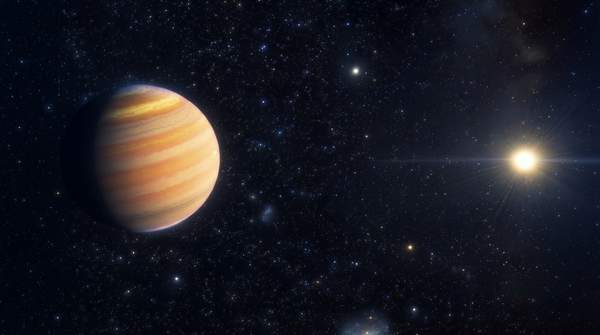
Transmission spectroscopy lets scientists determine the chemical composition of an exoplanet's atmosphere by analyzing starlight that filters through it during a transit. Because each element and molecule absorbs light at a specific pattern of wavelengths, the dips in the resulting spectrum act as a chemical fingerprint. Applied across different planet classes—hot Jupiters, sub-Neptunes, and super-Earths—the same technique yields different kinds of information, from the sodium- and water-rich envelopes of scorching gas giants to the oxygen, ozone, and methane that would mark a rocky world as potentially habitable. Atmospheric carbon-to-oxygen ratios, in turn, serve as tracers of where a planet formed relative to its star's ice line.
Understanding Transmission Spectroscopy: A Chemical Fingerprint
The method exploits a simple geometry. As an exoplanet moves in front of its host star, some of the starlight is absorbed by gas in the planet's atmosphere and some is transmitted through it. NASA, explaining a simulated spectrum of an Earth-like exoplanet observed with the James Webb Space Telescope, describes the result: each element or molecule in the atmosphere absorbs light at a very specific pattern of wavelengths, creating a spectrum with dips where light has been absorbed.
Each dip is effectively a signature. Recognize the signature, and you know that element or molecule exists in the atmosphere. For an Earth-like planet, the wavelengths of interest are those absorbed by oxygen, ozone, water, carbon dioxide, and methane. NASA cautions that even with Webb's large aperture, only some of the most prominent absorption features will be detectable, and even those will be extremely faint.
The technique's power scales with the atmosphere itself. A 2015 modeling study by Fortney and colleagues at UC Santa Cruz and the University of Washington explored how well JWST spectra will constrain the bulk atmospheric properties of archetypal hot Jupiter, warm Neptune, warm sub-Neptune, and cool super-Earth planets, considering clear, cloudy, and high-mean-molecular-weight atmospheres. Their work, and the broader literature it surveys, highlights why the same observation produces richer signals for some planets than others: large, hot, puffy atmospheres present more starlight-absorbing gas than thin, cool ones.