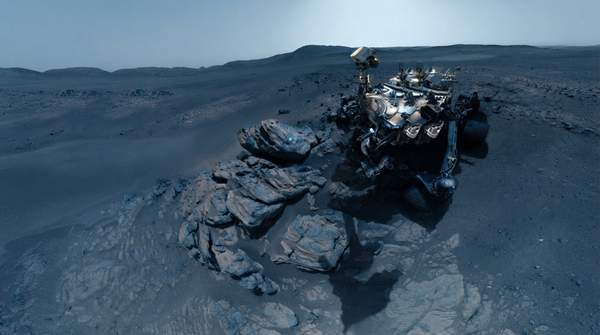
NASA's Perseverance rover searches for signs of past microbial life through a deliberate, multi-stage workflow: survey the landscape with zoomable cameras, probe promising rocks with a mast-mounted laser, examine targets at microscopic scale with arm instruments, and cache the most compelling samples for eventual return to Earth. Rather than a single life-detection experiment, the rover functions as a remote laboratory in which each instrument's findings guide the next step of the investigation.
Perseverance's Mission: The Search for Ancient Martian Life
A key objective for Perseverance, as NASA states, is astrobiology, including the search for signs of ancient microbial life. Unlike its predecessor Curiosity, the Mars 2020 rover was designed to focus on fine-grained mineralogy to help it detect biosignatures and understand how ancient habitats changed over time, according to The Planetary Society's coverage of NASA's instrument selections. The mission also carries a second, equally consequential task: collecting and storing samples of the Martian surface that could be returned to Earth.
The strategy has already produced results. In summer 2024, Perseverance investigated what one mission scientist called its "most puzzling, complex, and potentially important rock yet," a target nicknamed Cheyava Falls that showed signs of past water, organic material, and clues suggesting chemical reactions by microbial life. In September 2025, after a yearlong peer review, the journal Nature published validated results showing the "Sapphire Canyon" sample from that rock contains potential biosignatures — clues that suggest past life may have been present, but that require more data before any conclusion about the presence or absence of life.
Scouting the Martian Landscape: Mastcam-Z
The workflow begins at the widest scale. Mastcam-Z, a pair of zoomable cameras mounted on the rover's mast, provides high-resolution, multispectral imaging that connects sweeping multicolor panoramas with close-up 3D stereo detail. Arizona State University, which leads the Mastcam-Z investigation, describes the camera as the rover's scouting tool: its sharp eyes guide the rover toward the most promising spots for investigation.
It was Mastcam-Z imaging that revealed the distinctive "leopard spots" on Cheyava Falls in July 2024 — features scientists think may indicate that chemical reactions in the rock, billions of years ago, could have supported microbial life, though other explanations remain under consideration. Beyond target selection, these images help operators drive the rover and position its arm instruments, and analysis of the landing site's geology in Mastcam-Z imagery is helping scientists reconstruct the history of Jezero Crater and the rover's traverse region.
Remote Chemical Analysis: SuperCam
Once Mastcam-Z identifies a target, SuperCam takes the first chemical measurements — from a distance. Mounted on the mast as an upgraded version of Curiosity's ChemCam, SuperCam uses a laser to perform remote elemental and mineralogical analysis. As Will Wetzel reported in Spectroscopy, one study examined how SuperCam uses laser-induced breakdown spectroscopy (LIBS) and acoustic signal detection to analyze Martian samples in Jezero Crater: the laser vaporizes a tiny amount of rock surface, and the resulting light and sound reveal its composition.
This remote capability matters for the biosignature search because it lets the team gather initial chemical clues about rock composition before committing the rover's arm, saving time and allowing many targets to be triaged. SuperCam is one of three spectroscopy instruments in the seven-instrument suite, alongside SHERLOC and PIXL, and the suite was deliberately designed with overlapping capabilities so the rover could still achieve its science objectives if any single instrument failed.
Close-up Investigation: SHERLOC, WATSON, and PIXL
Targets that survive remote triage earn a visit from the rover's 7-foot robotic arm. SHERLOC — Scanning Habitable Environments with Raman & Luminescence for Organics & Chemicals — uses ultraviolet light and Raman spectroscopy to detect organic molecules and minerals, building hyperspectral maps of rock surfaces. Those maps are data-dense: by its 1,000th Martian day in December 2023, SHERLOC had scanned 34 rock targets and produced 261 hyperspectral maps, according to NASA's SHERLOC team update.
SHERLOC works in tandem with WATSON, a color camera on the same instrument that operates through a separate aperture and captures close-up images of rock grains and surface textures. The pairing is deliberate: WATSON provides the visual context — the tiny details — that place SHERLOC's chemical detections in geological context. PIXL, the Planetary Instrument for X-ray Lithochemistry, contributes fine-scale elemental mapping with X-rays. As NASA's Jet Propulsion Laboratory reported, the arm detectors, including SHERLOC and WATSON, analyze rocks with X-rays and ultraviolet light and zoom in on tiny segments of rock surfaces that might show evidence of past microbial activity.
Identifying Biosignatures: The Clues to Past Life
In the Martian context, a biosignature is not a photograph of a fossil but a cluster of mutually supporting clues: organic molecules, mineral textures, and chemical patterns that together suggest past microbial activity. The Cheyava Falls case illustrates how the instruments build such a case in concert. According to Arizona State University's account of the discovery, the imaging and spectral data from Mastcam-Z informed where PIXL, SHERLOC/WATSON, SuperCam, and RIMFAX ground-penetrating radar would investigate — a coordinated payload effort that culminated in collecting the Sapphire Canyon core.
Interpretation remains cautious by design. NASA characterizes the Sapphire Canyon result as a potential biosignature: clues suggesting past life may have been present, but requiring more data or further study before any conclusions about the absence or presence of life. Geological context is essential, as mission scientist Allwood put it, to place any indication of possible life in context and to test scientists' ideas about how a second example of life's origin could arise.
Perseverance Rover's Astrobiological Investigation Workflow
The sequence below models the scan-analyze-sample strategy as it was actually executed at Cheyava Falls, ordered by observation scale — from landscape to microscopic — and analytical capability. Each stage's output determines the next stage's input.
| Stage | Key Instruments | Action Performed | Scientific Goal |
|---|---|---|---|
| 1. Landscape survey | Mastcam-Z (mast) | High-resolution multispectral panoramas and stereo imaging; spot features like the leopard spots | Identify promising targets and geological context |
| 2. Remote analysis | SuperCam (mast) | Laser-induced breakdown spectroscopy and acoustic detection of rock composition from a distance | Gather initial chemical clues; triage targets |
| 3. Close-up analysis | SHERLOC, WATSON, PIXL (arm); RIMFAX (radar) | Raman and UV fluorescence mapping of organics and minerals; microscopic context imaging; X-ray elemental mapping; subsurface radar | Detect organic molecules, minerals, and textures that may constitute a biosignature |
| 4. Sample collection | Robotic arm and coring system | Core the target rock — as with the Sapphire Canyon core — and cache it | Preserve promising material for potential return to Earth |
This is a strategic deployment rather than a rigid, always-identical sequence: the instruments work in concert, with data from one informing where and how the next is used, and the mission team's judgment governs each decision point.
The Critical Role of Sample Collection and Earth Return
The workflow's final stage exists because the rover alone cannot close the case. Perseverance's instruments can identify potential biosignatures, but Earth-based laboratories offer more sophisticated analytical capabilities for conclusive evidence — which is why NASA frames the mission's sample collection as central to the search. During its first five years on the Martian surface, the rover has collected more than two dozen geologically diverse rock samples, including one containing potential biosignatures, while exploring the history of geology, water, and habitable environments in Jezero crater and on the crater rim.
The peer-review path from Cheyava Falls shows why this matters. The rover's data justified collecting the Sapphire Canyon core; a yearlong scrutiny of the Mars 2020 team's findings by outside reviewers, published in Nature in September 2025, validated the potential-biosignature result while explicitly leaving the question of life open pending further study. As The Planetary Society noted when the instruments were selected, the samples could be returned to Earth, though no return missions were yet planned at that time.
The Path to Proving Past Life on Mars
The Perseverance rover's systematic scan, analyze, sample workflow, leveraging its suite of advanced instruments, is crucial for identifying potential biosignatures and collecting samples for definitive analysis. The successful collection and caching of diverse rock and regolith samples, and their eventual return to Earth, will be a key indicator of progress towards answering whether life once existed on Mars. The measurable next milestone is already in hand: the Sapphire Canyon core, validated in Nature as containing potential biosignatures, now awaits the laboratory analysis that only an Earth return could provide.
Sources
- Mars 2020: Perseverance Rover - NASA Science
- [Updated]: NASA Selects 7 Science Instruments for its Next Mars Rover — The Planetary Society
- ASU-led camera helps scout location with potential biosignatures on Mars — NEWS
- Perseverance Science Instruments - NASA Science
- How NASA’s Perseverance Rover is Using Spectroscopy to Uncover the Secrets of Mars — Spectroscopyonline
- Team assessing SHERLOC instrument on NASA's Perseverance rover — Phys.org
- JPL
- Mars rovers serve as scientists’ eyes and ears from millions of miles away — The Conversation