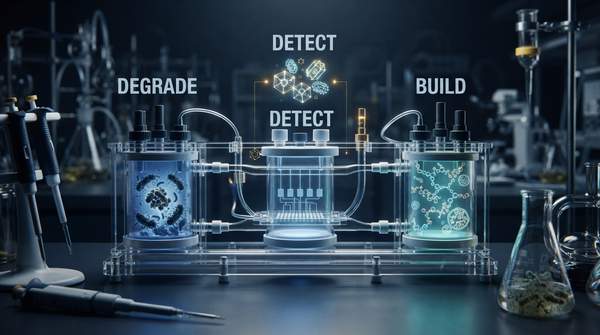
Synthetic biology's engineered microbes do three fundamentally different jobs: destroy a harmful substance, detect it, or manufacture something valuable from waste. The same underlying toolkit—DNA sequencing and synthesis, modular gene assembly, and computational design—gets bent toward radically different design goals depending on which job the microbe is hired to do. A bioremediation strain must survive harsh, unpredictable field conditions while breaking down a pollutant; a biosensor must translate the presence of a molecule into a readable signal; a biomanufacturing strain must convert cheap carbon feedstocks into a product efficiently enough to compete with petrochemical routes.
In a review published in Biotechnology for the Environment, a team including Tian Jiang, Nathan J. Hillson, and Di Liu frames these three tracks as the core environmental and industrial applications of metabolic engineering and synthetic biology. Their account, alongside recent analyses in Nature Communications and a review of synthetic biology resources, makes clear that the common toolkit diverges into application-specific design principles. What follows breaks each application into its engineering goal, strategy, and intended outcome, then places all three side by side.
Bioremediation: Engineering Microbes to Clean Our World
Bioremediation's design goal is deceptively simple: remove or neutralize a pollutant at a contaminated site. What makes it hard is the environment. A strain that degrades a compound cleanly in a flask faces heavy metals, fluctuating chemistry, competing organisms, and toxic substrates in the field. The engineering challenge is therefore twofold—the microbe needs a degradation capability, and it needs robustness to conditions it does not control.
The design response is visible in what researchers propose engineering. Reviewers of synthetic biology's application to xenobiotic pollution describe a design space that includes enzymes with unique activities toward persistent organic xenobiotics, organisms deliberately made resistant to challenging environmental conditions, and artificial storage organelles that sequester toxic metals. Each of these parts serves the same functional objective: keep the organism alive and active long enough at a contaminated site to detoxify it.
That objective covers a broad pollutant range. Jiang and colleagues note that microbial metabolic diversity offers great potential both to detoxify contaminants and to convert waste streams into value-added products—a dual framing that already begins to blur bioremediation into production. Data-driven design is entering this space too: researchers describing data-driven synthetic microbes (DDSMs) note that machine-learning-based protein engineering has improved the efficiency of PETase, the PET-degrading enzyme, illustrating how computational optimization sharpens the degradation function at the molecular level rather than only at the strain level.
Biosensors: Microbial Detectives for Environmental Monitoring
Biosensing inverts the bioremediation problem. The microbe's job is not to transform the target but to report it—to convert the presence and concentration of a specific molecule into a signal a human can read. Success is measured by detection quality: specificity, sensitivity, and timeliness, not by how much pollutant is removed.
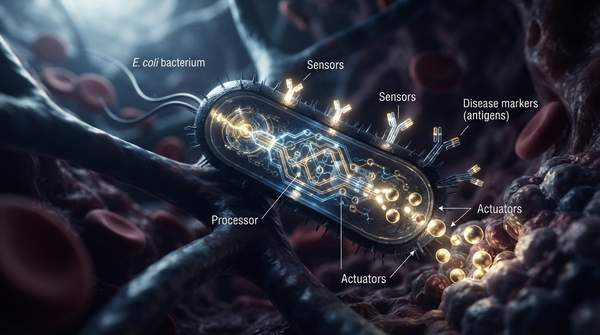
The engineering strategy follows from that goal. According to Jiang and colleagues, synthetic biology's catalog of characterized parts and design principles has enabled the development of novel biosensors that detect a diverse set of pollutants, including heavy metals and organic pollutants. The design work lies in wiring a sensing element—one that responds to the target molecule—to a readable output, using standardized, interchangeable genetic parts rather than bespoke circuits for every contaminant.
The payoff these systems aim at is monitoring and early warning: real-time detection of environmental conditions, the same reviewers note, enables precise tracking of pollution rather than infrequent manual sampling. The biosensor and the remediator are natural complements—one finds and measures the problem, the other fixes it—and both appear in the same reviews, but they impose different demands on the organism. A sensor deployed in the environment still needs environmental tolerance, yet its central engineered function is signal generation, and its output is information rather than a cleaned site.
Sustainable Chemical Production: Biomanufacturing for a Greener Future
Biomanufacturing changes the design goal again: here the microbe is a factory, not a cleanup crew or a gauge. The objective, as Jiang and colleagues define it, is microbial conversion of abundant, low-cost carbon feedstocks into valuable products such as biomaterials, biofuels, and natural compounds. The design target is the metabolic pathway itself—rerouting carbon flux so the cell diverts resources into the desired compound instead of growth.
This is where metabolic engineering is most central. Rather than adding a single degradation enzyme or a sensing circuit, the engineer optimizes an entire production pathway, balancing competing metabolic demands to raise yield and productivity. The DDSM framework described by researchers on data-driven synthetic microbes extends this: strains are designed and optimized using knowledge from multi-omics data, computational models, and simulations, with a systems biology approach used to predict and fine-tune metabolic behavior. The stated application range of these data-dependent microbes runs explicitly from bioremediation to sustainable bioproduction—evidence that the computational toolbox serves both destroy-and-build ends of the spectrum.
Notably, this application connects most directly to resource recovery: waste streams that bioremediation treats as a disposal problem become feedstocks that biomanufacturing treats as raw material. The detoxification and production tracks can converge on the same substrate, but the engineered output differs—one aims at a detoxified site, the other at a recovered, saleable product.
Comparing Synthetic Biology's Environmental and Industrial Applications
Setting the three applications against consistent criteria—goal, engineering strategy, and outcome—reveals why identical tools produce different organisms. The comparison below juxtaposes the three tracks as described across the cited reviews, including the Nature Communications analysis of engineering biology's environmental potential.
| Application Area | Primary Goal | Engineering Strategy Example | Desired Outcome/Product |
|---|---|---|---|
| Bioremediation | Remove or neutralize environmental pollutants, including heavy metals and organic pollutants, at contaminated sites | Engineer microbes with enzymes targeting persistent organic xenobiotics; design organisms resistant to challenging environmental conditions; artificial storage organelles for toxic metals | Detoxification of contaminated sites; environmental solutions and resource recovery |
| Biosensors | Detect the presence and concentration of specific target molecules or pollutants, including heavy metals and organic pollutants | Assemble characterized synthetic biology parts and design principles into sensing circuits for pollutant monitoring and biodetection | Real-time detection, early warning, and precise monitoring of environmental conditions |
| Sustainable Chemical Production | Produce valuable chemicals and materials—biomaterials, biofuels, natural compounds—from abundant, low-cost carbon feedstocks | Metabolic engineering to optimize microbial pathways for efficient synthesis; data-driven synthetic microbes (DDSMs) designed from multi-omics data and computational models | Value-added products from waste streams; sustainable biomanufacturing |
The pattern the table exposes is that goal drives design. Degrading a persistent compound demands environmental robustness and catabolic enzymes; detecting a compound demands a specific, sensitive output circuit; producing a compound demands pathway-level flux optimization. The same parts library serves all three, but the selection pressure on the organism differs completely.
The wider context matters too. The Nature Communications authors—David J. Lea-Smith and colleagues, spanning environmental engineering and synthetic biology—argue that scaling engineered systems and their digital twins to real-world applications requires better understanding to bridge the gap between lab conditions and complex environments. They further emphasize that developing suitable standards and addressing ethical, regulatory, and societal dimensions plays a significant role in deploying synthetic biology applications. In other words, the design problem does not end with the organism; deployment is part of the engineering.
Navigating the Future of Synthetic Biology: A Path Forward
Recognize that the successful deployment of synthetic biology solutions for environmental and industrial challenges requires addressing scaling, regulatory, and public acceptance hurdles—not merely demonstrating function in the lab. The distinction between a working strain and a deployed one is where these three applications currently stand: the design principles are established for each track, but the gap between lab conditions and complex environments remains the acknowledged bottleneck across the literature.
The measurable indicators to watch are the ones the evidence points to: increased investment in pilot projects that move engineered microbes out of flasks into field conditions, clearer regulatory guidelines and standards for environmental release, and growing public engagement with synthetic biology applications. Each is an observable, countable development—and each marks progress on the specific hurdle that separates a designed microbe from one doing its intended job in the world.