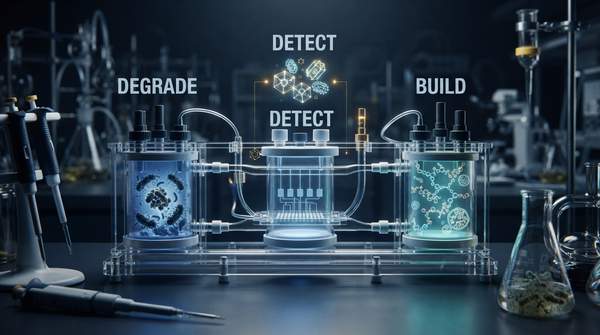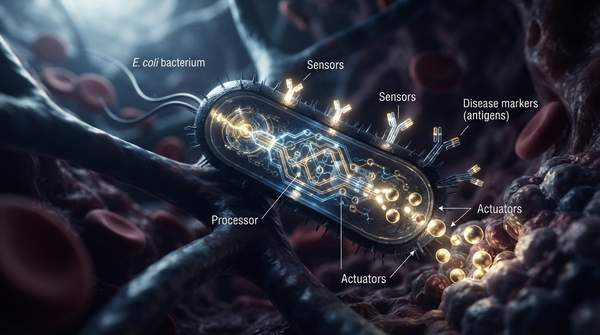
Synthetic biology engineers bacteria into programmable "living medicines" by giving them three coordinated jobs: sense a disease signal inside the body, process that signal through a genetic circuit, and act by producing and releasing a therapeutic compound at the target site. Research on microbiota therapeutics shows that engineered bacteria can be designed to deliver therapeutic compounds to precise locations such as the gastrointestinal tract, releasing their cargo in response to specific environmental triggers to improve accuracy and efficacy while minimizing side effects. This article breaks that system into its modules and then examines why moving it into human bodies remains hard.
Introduction to Engineered Microbes for Drug Delivery
Synthetic biology is a multidisciplinary field that integrates principles from computer science, engineering, and biology to design and manipulate biological systems, as described in research on microbiota therapeutics. Applied to microbes, it allows researchers to treat a bacterium not as a static drug but as a chassis that can be rationally programmed. A review by Xu Yan, Xu Liu, Cuihuan Zhao, and Guo-Qiang Chen in Signal Transduction and Targeted Therapy describes how researchers build therapies from living cell chassis using constructs derived from existing signaling networks, for purposes including the production of medical biomolecules and synthetic gene networks for sensing or diagnostics.
The appeal of a bacterial chassis for drug delivery is autonomy. Rather than a pill that dumps its dose everywhere, an engineered microbe can in principle wait until it encounters the conditions of a disease site, then act. According to the microbiota therapeutics literature, this targeted approach has the potential to maximize therapeutic outcomes while limiting side effects—but realizing that potential depends on how the three functional modules below are chosen and assembled.
The Three Functional Modules of an Engineered Therapeutic Microbe
The clearest way to understand a therapeutic microbe is the "Sense-Process-Act" framework: a sensing module that detects a disease state, a processing module that decides when and how to respond, and an actuation module that produces the therapeutic effect. Each module draws on a different toolkit of genetic parts, and the therapeutic behavior only emerges when they are integrated into one system.
| Functional module | Mechanism / components | Role in drug delivery | Qualification |
|---|---|---|---|
| Sensing | Genetically engineered biosensors detect disease biomarkers or environmental signals | Identifies the target site or disease state within the body | Real-time, continuous, multi-target detection |
| Processing | Genetic circuits built from promoters and logic elements regulating gene expression | Decision-making unit determining when and how to activate the therapeutic output | Response kept specific and controlled in response to internal or external cues |
| Actuation | Production and release of therapeutic compounds such as proteins or small molecules | Delivers the therapeutic effect at the targeted site | Cargo released in response to signals processed by the circuits |
Reading the table as a pipeline rather than a parts list is the point: sensing without processing yields no specificity, and processing without actuation yields no therapy. The following sections examine each module's evidence base.
The Sensing Module: Detecting Disease Signals
A review on engineered live bacteria as detection tools explains that bacteria can be programmed with simple genetic rules, basic logic gates, and synthetic bioengineering principles to act as living machines that detect disease biomarkers—some of which cannot be detected by other sensing technologies. Work on bacterial biosensors in medicine, by Mengting Liu, Wenjie Yang, Wenqi Zhu, and Daojun Yu in Frontiers in Microbiology, characterizes these sensors as enabling real-time, continuous monitoring and simultaneous multi-target detection through genetic engineering, in contrast to the static, largely single-target detection of conventional diagnostics such as ELISA, PCR, or imaging.
For drug delivery, the same sensing capacity serves as the targeting mechanism. The microbiota therapeutics literature describes bacteria programmed to release therapeutic cargo "in response to specific environmental triggers or conditions"—that is, the sensor defines where and when the therapy fires, whether the cue is a disease biomarker or a change in local conditions.
The Processing Module: Genetic Circuits for Controlled Response
Once a signal is sensed, something must translate it into a decision, and that is the role of the genetic circuit. The Signal Transduction and Targeted Therapy review identifies promoters as a key element in regulating gene expression at the transcriptional level, making them a central consideration in the design of synthetic circuits. Circuit design determines whether the response is specific and controlled rather than a simple always-on output.
Notably, the same review reports that machine learning is now being applied to this design problem: because trial-and-error metabolic engineering is time-consuming and laborious, ML can analyze large amounts of biological data to support predictions in genetic circuit design, pathway design and optimization, and screening, including the design and optimization of promoter sequences. This matters for drug delivery because the processing module is what converts a raw environmental reading into a conditional therapeutic instruction.
The Actuation Module: Delivering Therapeutic Outputs
The final module is the payload itself. Engineered bacteria can be programmed to produce and release therapeutic compounds—including proteins and small molecules—at the site where their sensors and circuits indicate a disease state. The microbiota therapeutics review frames this as the payoff of the whole architecture: delivery directed to specific sites improves treatment efficacy while minimizing side effects, because the therapeutic effect is concentrated where the disease signals are.
This closed-loop quality is what distinguishes a therapeutic microbe from a conventional drug. The Frontiers review describes bacterial biosensors as supporting "closed-loop detection-treatment systems," in which detection and treatment are integrated rather than separated into diagnosis and therapy. In the three-module model, the actuation module is where the system's decision becomes a physical therapeutic event.
Key Challenges and Safety Considerations for In-Vivo Applications
The framework above is well supported conceptually, but translating it into patients faces substantial hurdles. The Signal Transduction and Targeted Therapy review states plainly that many efforts are still needed to weaken bacterial toxicity and increase controllability in vivo. Genetic stability of the engineered constructs, environmental safety, and robust regulatory frameworks are highlighted in the microbiota therapeutics literature as challenges requiring ongoing research before interventions are safe and effective.
Delivery itself is part of the problem. A review on synthetic biology-based engineering of cells for drug delivery notes that a significant challenge in applying engineered cells within the body is overcoming biological barriers and resistance in diseased tissues, which hinder the delivery of therapeutic agents to target cells. Safety concerns such as immunogenicity and off-target effects must be carefully addressed, along with unintended interactions between engineered microbes, host cells, and the native microbiome.
These are not peripheral issues—they determine whether a circuit that works in a culture flask still behaves predictably in the complex environment of a human body, and they are the reason clinical translation remains slow.
Future Outlook: Advancing Engineered Microbes for Clinical Use
Continued research and development must focus on enhancing the precision, safety, and stability of engineered microbes in vivo to move from experimental models to clinical applications. The Sense-Process-Act model shows why: each module multiplies the others' risks, so an unstable circuit or an off-target sensor undermines the entire therapeutic. The measurable indicator to watch is successful clinical trials demonstrating long-term genetic stability, minimal immune response, and predictable therapeutic delivery in human subjects. Until such trials exist, the framework remains a laboratory design logic rather than a clinical reality—and the field's progress toward those three benchmarks is the concrete signal of whether engineered microbes are becoming medicine.
Sources
- Advancing microbiota therapeutics — PMC
- Applications of synthetic biology in medical and pharmaceutical fields - Signal Transduction and Targeted Therapy — Nature
- Engineered live bacteria as disease detection and diagnosis tools - PMC
- Frontiers | Innovative applications and research advances of bacterial biosensors in medicine
- Synthetic Biology‐Based Engineering Cells for Drug Delivery - PMC