Synthetic biology attacks environmental pollution with two fundamentally different playbooks, and the choice between them is dictated by chemistry. When the contaminant is an organic compound—petroleum hydrocarbons from an oil spill, for instance—engineers rework microbial metabolism so the pollutant itself becomes food, broken down into less toxic substances. When the contaminant is a heavy metal, no microbe can "degrade" it, because the element cannot be dismantled; instead, engineers design biological systems that capture and immobilize it. That single distinction—degradation versus sequestration—organizes the entire field.
Introduction to Synthetic Biology and Bioremediation
Microbes already clean up pollution on their own, and that intrinsic capacity is the foundation bioremediation builds on: through their metabolic processes, microorganisms degrade pollutants and convert them into less toxic substances. But the natural version of this ability is unreliable. Reviews of microbial bioremediation describe recurring limitations such as incomplete breakdown of organic pollutants, low remediation efficiency, and the fact that the process works only for contaminants that are biodegradable in the first place.
Synthetic biology enters precisely at that boundary. Rather than relying on whatever metabolic machinery a wild strain happens to carry, researchers can redesign the organism itself—rewiring metabolic pathways, modifying enzymatic properties, and assembling organisms into engineered consortia. A review published in the Journal of Environmental Protection (Vol. 24, No. 1, 2025) frames the field's ambition in exactly these terms: complete re-engineering of metabolic pathways for the degradation of target pollutants is now conceptually possible, even though optimization remains genuinely difficult.
Understanding what follows requires keeping the pollutant classes separate. Organic pollutants are molecules that can, in principle, be taken apart bond by bond. Inorganic pollutants such as heavy metals are elements; biology cannot destroy them, only move them, bind them, or lock them away. Every engineering decision downstream flows from that chemical reality.
Engineering Microbes for Organic Pollutant Degradation
Oil spills are the paradigm case, and a study published in Genetics and Molecular Research makes the case for engineered organisms bluntly. Its authors note that conventional remediation methods like chemical dispersants and mechanical recovery are often inefficient and costly, and may even produce secondary pollution. Against that backdrop, recent advances in synthetic biology are positioned as a route to engineer microorganisms for enhanced hydrocarbon degradation, using genetic and metabolic engineering to boost bioremediation efficiency beyond what native microbes achieve.
The mechanism is metabolic. For organic pollutants, the biological goal is degradation into less harmful substances, achieved through microbial metabolic processes. The synthetic biology strategy is to design novel degradation pathways or optimize existing ones—re-engineering the network of enzymes and reactions so that complex hydrocarbons are funneled into the microbe's central metabolism more completely than nature manages on its own. The same review logic extends to enzymatic properties, which can themselves be modified to better match the contaminant at hand.
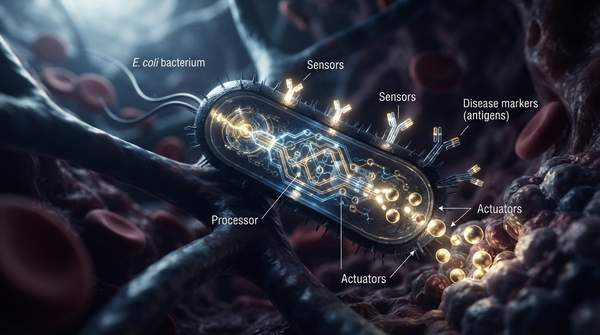
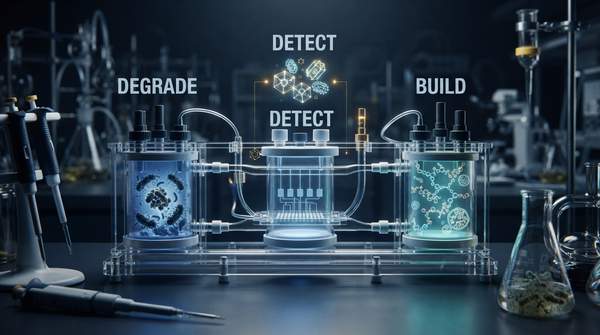
Two design features recur across this strategy. First, synthetic biology-based biosensors are used to detect pollutant levels and to study how microbes interact with pollutants in complex environments—an engineered feedback layer that natural bioremediation lacks. Second, rather than loading every capability into a single chassis organism, researchers increasingly assemble synthetic microbial consortia, which the 2025 review credits with surpassing the limitations of an individual synthetic bacterium during pollutant remediation. In a consortium, different member strains can specialize in different steps of a degradation cascade.
Designing Systems for Inorganic Pollutant Sequestration
Heavy metals break the degradation playbook entirely. Because they are elements, they cannot be metabolized away; the biological goal shifts from destruction to containment. The aim is sequestration or immobilization—trapping the pollutant so it cannot spread through soil, sediment, or water, which in turn reduces its effective toxicity at the contaminated site.
A review hosted in the White Rose repository, addressing both organic xenobiotics and heavy metals, sketches the engineering approach in concrete biochemical terms. It proposes focusing in situ approaches on trapping pollutants in biological chelators such as metallothioneins, and in absorbents such as nanofibers—materials that, over time, can become locked into soils and sediments and then monitored with biosensors.
What synthetic biology adds is the ability to design the trapping apparatus itself. The same review describes synbio approaches enabling the design of synthetic bio-based compounds and self-assembling artificial storage organelles to trap inorganic pollutants, or to enable their cost-effective recovery. The engineering target here is not a pathway but a structure: a molecular or organelle-scale container that binds the metal and holds it. Biosensors again play a supporting role, providing the monitoring capacity needed to verify that trapped metals stay put.
Synthetic Biology Strategies for Environmental Bioremediation
The framework below sorts each pollutant class by its target, biological goal, and engineering route, so a scientist confronting a specific site can identify the correct strategy at a glance.
| Pollutant Class | Target Example | Biological Goal | Synthetic Biology Strategy |
|---|---|---|---|
| Organic pollutants (e.g., hydrocarbons and other complex organic compounds) | Oil spills (hydrocarbon contamination) | Degradation into less harmful substances via microbial metabolic processes | Engineer microorganisms with enhanced or re-designed metabolic pathways, including modified enzymes; support with biosensors and synthetic microbial consortia |
| Inorganic pollutants (heavy metals, which are not biodegradable) | Heavy metals such as nickel and metalloids in contaminated soils and sediments | Sequestration or immobilization, preventing spread and reducing toxicity | Design biological chelators such as metallothioneins, synthetic bio-based compounds, and self-assembling artificial storage organelles to trap pollutants; monitor with biosensors |
Read across the rows and the underlying logic emerges: the pollutant's chemical nature—not the microbe—determines the strategy. Organic compounds are addressed by metabolic degradation because their bonds can be enzymatically broken; inorganic pollutants are managed through capture because they cannot.
Challenges in Real-World Application
The gap between engineered promise and environmental deployment remains wide, and the 2025 review is explicit that many challenges limit the application of synthetic biology to industrial wastewater pollutants. Optimization itself is flagged as difficult: re-engineering a metabolic pathway for one target compound does not automatically yield a system that performs in a complex, variable effluent containing many interacting contaminants.
The biosensor and consortium tools described above cut both ways. They are the field's answers to complexity—detecting pollutant levels in real conditions, distributing degradation across multiple strains—but they also multiply the engineering variables that must be stabilized before a system can be trusted in an industrial or field setting. A consortium that outperforms a single synthetic bacterium in principle still has to survive, coordinate, and keep functioning in a real environment.
The inorganic strategy carries its own time-bound constraint. The chelator-and-nanofiber approach depends on trapped metals becoming locked into soils and sediments over time, meaning success is verified through long-term monitoring rather than a one-time treatment—hence the review's insistence that locked pollutants be watched with biosensors rather than assumed neutralized.
Advancing Bioremediation: Next Steps for Environmental Scientists
Environmental scientists and biotechnologists should focus on developing robust, scalable engineered microbial systems that can perform effectively in complex, real-world conditions rather than under optimized laboratory parameters. The core distinction this article establishes—metabolic pathway engineering for organic pollutants, trapping structures for inorganic ones—should guide both research programs and site assessments: match the strategy to the contaminant's chemistry first, then optimize the chassis.
The measurable indicator of progress the evidence supports is concrete: successful field trials demonstrating stable performance of engineered microbes, together with clear regulatory pathways for deployment. Until engineered consortia hold their function outside the flask—and until regulators define how they may be released at contaminated sites—synthetic biology's bioremediation promise remains a laboratory capability with its decisive tests still ahead.