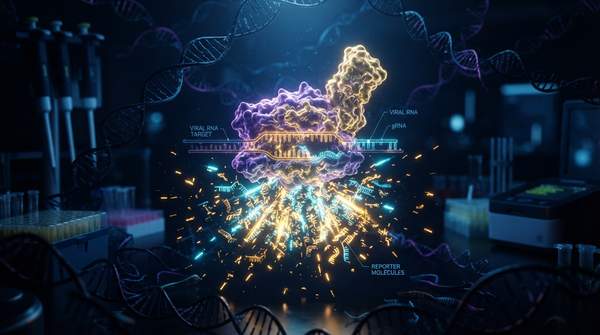
CRISPR-based diagnostics achieve their remarkable sensitivity and specificity through a two-part molecular strategy: programmable nucleic acid recognition by a guide RNA, followed by an enzyme-driven signal amplification step known as collateral cleavage. When a single target molecule binds the Cas enzyme's guide, the enzyme switches on a nonspecific cutting activity that shreds many nearby reporter molecules, converting one binding event into a strong, detectable signal. Platforms such as SHERLOCK and DETECTR, described by Zhenzhen Pan and colleagues in Frontiers in Cellular and Infection Microbiology, pair this mechanism with reporter systems to achieve ultra-sensitive detection of pathogen-specific nucleic acids.
The Core Principle: Programmable Detection
The starting point is the biology of bacterial immunity. CRISPR/Cas systems mediate an adaptive immune response in bacteria and archaea through programmable, sequence-specific recognition and cleavage of foreign nucleic acids, as outlined in a review of CRISPR/Cas applications in molecular diagnostics. Diagnostics borrow this natural machinery: rather than editing genes, the Cas enzyme is repurposed as a sequence-finding sensor coupled to a readout.
The programmability is what makes the approach flexible. As Jennifer Bennett explains in a Synthego guide, a designer chooses a guide RNA to match the sequence of interest, and Cas enzymes—typically Cas12 or Cas13—use that guide to find the target in a sample. Changing the target means changing the guide RNA, not redesigning the whole assay. A review in CRISPR-driven diagnostics literature notes that through the dual mechanisms of programmable nucleic acid recognition and enzyme-mediated signal amplification, CRISPR-based assays can surpass conventional PCR in workflow simplicity and cost-effectiveness, with reported reagent costs of $2–5 per test.
Step 1: Precise Target Recognition
Specificity begins with base pairing. The guide RNA—also called a crRNA—is designed to be complementary to a specific target nucleic acid sequence, whether DNA or RNA, in the sample. Only when the crRNA and target match does the diagnostic reaction proceed. This pairing requirement is the molecular gatekeeper: a mismatched sequence fails to activate the enzyme, and no signal is produced.
This is why the approach suits both pathogen detection and genetic screening. A guide can be designed against a pathogen's genomic sequence or against a specific variant of interest, and the recognition step discriminates between them. Pan and colleagues note that variant-specific guide RNAs are part of what makes these platforms adaptable to emerging threats. The recognition stage alone, however, only finds the target; it does not yet produce a signal strong enough to see. That job falls to the enzyme's second, more unusual activity.
Step 2: Cas Enzyme Activation and Collateral Cleavage
The decisive event is activation. Upon perfect crRNA–target pairing, a single nucleic acid molecule activates the collateral nuclease activity of Cas12 or Cas13, which then processively cleaves fluorogenic or electrochemical reporter substrates. This indiscriminate cutting of nearby, non-target molecules is called trans-cleavage, or collateral cleavage, and it is the engine of signal amplification.
The logic is a cascade. One recognition event arms one enzyme. That armed enzyme is not limited to cutting the target it found—it becomes a generalist nuclease that keeps slicing reporter molecules in its vicinity. The enzyme acts processively, meaning it cleaves repeatedly rather than once and stopping. The Frontiers review by Pan and colleagues describes this as leveraging the inherent trans-cleavage activities of Cas enzymes, combining target recognition precision with reporter systems. Notably, this amplification is intrinsic to the enzyme itself: a review of amplification-free CRISPR assays explains that trans-cleavage serves as an internal signal amplification mechanism, allowing assays to work without conventional nucleic acid amplification and its demands for thermal cyclers and multi-step workflows.
Step 3: Signal Amplification and Detection
The reporters are the visible output. These are short nucleic acid probes tagged with a fluorophore and a quencher—or connected to electrochemical or colorimetric readouts. Intact, they stay dark. When the activated Cas enzyme cuts them, the fluorophore separates from the quencher and fluorescence appears, or a color change becomes visible to the eye.
The amplification arithmetic is what delivers sensitivity. Because each activated enzyme can cleave many reporter molecules, a single target molecule in the sample can generate a large, measurable signal. This is how minute amounts of pathogen DNA or RNA become detectable, and why the technology is described as ultra-sensitive. The CRISPR-driven diagnostics review concludes that the field's unprecedented sensitivity, specificity and rapid detection capabilities stem directly from these dual mechanisms, with clinical validations demonstrating practical utility in detecting drug-resistant bacteria and emerging viruses, and multiplex platforms enabling simultaneous analysis of up to 14 targets.
The CRISPR Diagnostic Workflow: From Target to Signal
Tracing the full causal chain makes clear how each stage contributes to the final result. The table below deconstructs the diagnostic process into its discrete molecular events, showing how a single target molecule becomes a massively amplified reporter signal.
| Stage | What Happens | Key Component | Contribution to Performance |
|---|---|---|---|
| 1. Target recognition | A guide RNA (crRNA) complementary to the target sequence pairs with the pathogen or marker nucleic acid in the sample | crRNA + Cas12 or Cas13 | Base-pairing requirement gives the test its specificity |
| 2. Enzyme activation | Perfect crRNA–target pairing switches on the enzyme's nuclease activity | Activated Cas enzyme | Only a true match triggers the reaction, preventing false activation |
| 3. Collateral (trans) cleavage | The activated enzyme indiscriminately and processively cleaves nearby non-target reporter molecules | Collateral nuclease activity | One binding event drives cleavage of many reporters—the amplification step |
| 4. Signal generation | Cleaved reporters release a detectable signal such as fluorescence, or a color change | Fluorogenic or electrochemical reporters | Amplified output makes minute target amounts visible |
Reading the table as a chain: recognition ensures the right target is found, activation ensures only a genuine match proceeds, collateral cleavage multiplies the response, and reporter cutting converts that multiplication into an observable result. Remove any stage and the assay fails—without recognition there is no specificity, and without collateral cleavage there is no sensitivity beyond the single binding event itself.
Key Cas Enzymes: Cas12 vs. Cas13 in Diagnostics
The two flagship platforms differ mainly in which nucleic acid they target. SHERLOCK (Specific High-sensitivity Enzymatic Reporter unLOCKing) is built on Cas13, an enzyme that targets RNA, making it a natural fit for RNA viruses. DETECTR (DNA Endonuclease-Targeted CRISPR Trans Reporter) uses Cas12, which targets DNA, suiting it to DNA pathogens and genetic markers such as those in circulating tumor DNA, an application Deliana Infante notes in coverage of CRISPR diagnostic developments for News-Medical.
The choice of enzyme therefore dictates test design: detecting an RNA virus with a Cas12-based system would require a reverse-transcription step, while a Cas13 system reads RNA directly. Both enzymes share the same collateral cleavage behavior described above, which is why both platforms achieve ultra-sensitive detection despite targeting different molecules. In many workflows, as Bennett notes, the CRISPR detection step is paired with a preliminary amplification stage such as RPA or RT-RPA to increase the amount of target material—though the trans-cleavage mechanism itself provides intrinsic amplification, and amplification-free designs exist. This article focuses on the core collateral-cleavage principle rather than the full landscape of engineered variants or commercial kits.
Evaluating CRISPR Diagnostics for Clinical Potential
Clinicians and researchers can assess the suitability of CRISPR-based diagnostics for specific applications by understanding that their high sensitivity and specificity stem from programmable target recognition combined with a powerful collateral cleavage-mediated signal amplification mechanism. The enzyme choice—Cas13 for RNA targets, Cas12 for DNA—maps directly onto the clinical question at hand, from RNA virus detection to DNA-based genetic screening.
The observable signal for a successful CRISPR diagnostic test is the rapid generation of a detectable reporter signal (e.g., fluorescence or color change) in the presence of the target nucleic acid, even at very low concentrations. That readout, appearing within a single reaction and without a thermal cycler in amplification-free designs, is the concrete indicator to watch when judging whether a given platform is ready for the point-of-care settings where its speed and low cost matter most.
Sources
- Frontiers | CRISPR-based diagnostics for infectious diseases: mechanisms, advancements and clinical transformation…
- Advances in the Application of CRISPR/Cas Systems in Molecular Diagnostics — SCIEPUBLISH
- CRISPR‐driven diagnostics: Molecular mechanisms, clinical efficacy and translational challenges - PMC
- CRISPR-Based Diagnostics: The Future of Disease Detection — News-Medical
- The Rise of CRISPR Diagnostics - Synthego