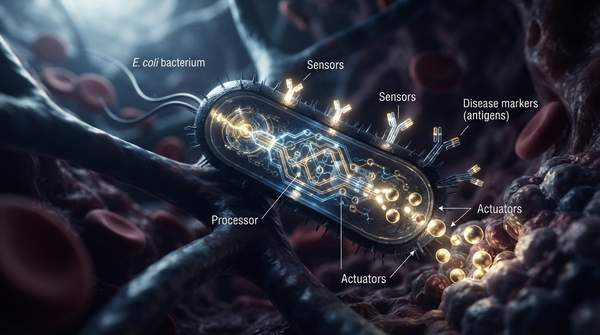
Designing a synthetic microbial community for therapy means engineering bacteria to do three things in sequence: sense a disease-relevant signal in the gut, process that signal through a genetic circuit, and actuate a therapeutic response such as producing a beneficial compound. Two engineering strategies make this possible—metabolic pathway engineering that distributes biochemical labor across strains, and genetic circuit design that coordinates behavior between them—while stability and biocontainment considerations determine whether the system can ever leave the laboratory.
Introduction to Therapeutic Synthetic Microbial Communities
Synthetic biology, as Asiya Nazir and colleagues at Frontiers describe it, is a multidisciplinary field that integrates computer science, engineering and biology to design biological systems that perform specific functions. Applied to the gut, it allows researchers to engineer probiotics that target infectious agents, produce therapeutic compounds, or modify gut microbiota to improve outcomes in conditions such as inflammatory bowel disease and metabolic disorders. Engineered communities may also replicate natural ecosystems, giving researchers a controlled way to study microbial interactions and host-microbiota dynamics.
What distinguishes a consortium from a single engineered strain is division of labor. A review of design principles for synthetic microbial communities notes that community engineering allows diversification of biochemical roles in breaking down complex substrates and optimized compartmentalization of pathways between individuals, so multiple functions execute simultaneously with reduced burden on any single organism. That principle—spreading the work—is the foundation on which therapeutic consortia are built.
Core Components of an Engineered Therapeutic Consortium
Any engineered therapeutic community can be deconstructed into functional modules, much like a control system. The first is a sensing module: an input that detects an environmental cue, such as a disease biomarker or a harmful toxin in the gut. The second is a processing module, implemented as a genetic circuit that interprets the sensed signal and decides whether—and when—to respond. The third is an actuation module: the therapeutic output itself, which according to Nazir and colleagues can be the production of therapeutic compounds or enzymes that break down harmful toxins, improving gut health.
The chassis organism carrying these modules matters as much as the modules themselves. The Frontiers authors describe engineered probiotics as a natural chassis choice for gut applications, and note that synthetic biology techniques can tailor strains to address specific dysbiosis or deficiencies within a patient's microbiota. Selecting a chassis therefore involves matching the organism's native physiology to the environment it must survive in and the function it must deliver.
Engineering Strategy 1: Metabolic Pathway Engineering for Division of Labor
The first major strategy treats the community as a distributed metabolic factory. Rather than loading one strain with an entire biosynthetic pathway, engineers split the pathway across multiple strains, each executing one step. The design-principles review describes this as optimized compartmentalization of pathways between individuals, enabling simultaneous execution of multiple functions with reduced individual burden. For a therapeutic consortium, that could mean one strain converting a dietary or host-derived substrate into an intermediate, and a second strain completing the synthesis of the therapeutic compound.
Predicting how such divided labor behaves requires quantitative tools. The review highlights metabolic modeling as a way to predict metabolite flux and exchange in microbial communities, citing a model of two Geobacter species that parameterized their metabolite exchange and direct electron transfer to characterize their syntrophic growth dynamics. The authors argue that computational tools are needed to better predict the behavior and impact of engineered genetic pathways on community dynamics—a requirement that becomes critical when the exchanged metabolite is a therapeutic intermediate rather than an incidental byproduct.
Engineering Strategy 2: Genetic Circuit Design for Inter-species Communication
The second strategy addresses coordination. Genetic circuits are the processing layer that lets strains sense environmental cues, communicate with one another, and act collectively. The design-principles review emphasizes that defined intercellular and spatiotemporal coordination enables precise consortia engineering: circuits can couple the presence of a biomarker in one strain to the activation of a therapeutic response in another, so the community behaves as an integrated system rather than a collection of independent organisms.
This is where the sensing-processing-actuation architecture becomes concrete. A circuit in the sensing strain might trigger production of a signaling molecule when it detects a target condition; a circuit in the actuating strain detects that signal and responds by producing the therapeutic compound. The review's summary of community design and utility frames this as the core advantage over single-strain engineering—coordination itself is a designable property, not an emergent accident.
Key Design Considerations for Stability and Safety
Engineering a community that works once in a flask is not the same as engineering one that works in a patient. The design-principles review states plainly that community robustness and stability should be assessed and designed into synthetic systems, and that deployment of biocontainment and population control measures is needed for real-world applications. Robustness here means maintaining composition and function against environmental perturbations; stability means the engineered traits persist over time rather than being lost.
Nazir and colleagues frame the same challenges at the translational level: genetic stability, environmental safety, and robust regulatory frameworks must be addressed through ongoing research to ensure safe and effective microbiome interventions. For designers, these translate into concrete obligations—engineering circuits that do not burden their hosts enough to be selected against, and building containment that prevents the community's unintended dissemination beyond the patient.
Explanatory Model of a Therapeutic Microbial Consortium
The framework below deconstructs a model therapeutic consortium into its functional blocks, mapping each engineering principle to its role in the community. Trace the flow from top to bottom to follow information and function from environmental sensing to coordinated therapeutic action.
| Module | Engineering Principle | Function in the Community | Key Design Aspect |
|---|---|---|---|
| Chassis organisms | Strain selection and tailoring | Host the modules; suited to gut survival and patient-specific dysbiosis | Match native physiology to target environment |
| Sensing module (input) | Biomarker or toxin detection | Detects the disease-relevant trigger in the gut | Specificity to the target cue |
| Processing module | Genetic circuit design | Interprets the signal; coordinates behavior between strains | Defined intercellular and spatiotemporal coordination |
| Actuation module (output) | Therapeutic compound or enzyme production | Delivers the therapeutic response, e.g., breaking down harmful toxins | Output timed to the sensed condition |
| Inter-species communication link | Metabolic exchange and signaling | Connects strains; carries intermediates and signals between modules | Predicted flux and exchange via metabolic modeling |
Reading the table as a system: the chassis provides the physical substrate; the sensing module detects the trigger; the genetic circuit processes that input and, through the communication link, instructs the actuating strain; the actuation module produces the therapeutic output. Metabolic engineering supplies the division of labor that keeps each strain's burden low, while circuit design supplies the coordination that makes the response conditional on the biomarker. Every cell in the model traces back to the design principles described above—compartmentalized pathways, defined coordination, and engineered actuation.
Designing for Therapeutic Impact: Key Takeaways
When designing synthetic microbial communities for therapeutic applications, prioritize modularity in component design—sensing, processing, and actuation—and integrate robust inter-species communication mechanisms. The two strategies are complementary rather than competing: metabolic engineering distributes the biochemical workload, and genetic circuits ensure the distributed parts act together only when the target condition is present. Robustness, stability and biocontainment are not afterthoughts but design inputs from the outset.
The measurable indicator of success at the design stage is successful in vitro validation of coordinated multi-strain function and stable therapeutic output in response to a target biomarker. That benchmark—multiple engineered strains responding as one system, with the output tied to the sensed trigger—is what separates a functioning therapeutic consortium from a collection of engineered parts, and it is the milestone any such design must clear before questions of clinical translation can even begin.